MY STORY
I Didn’t Need a Midlife Crisis Talk. I Needed a Fire.
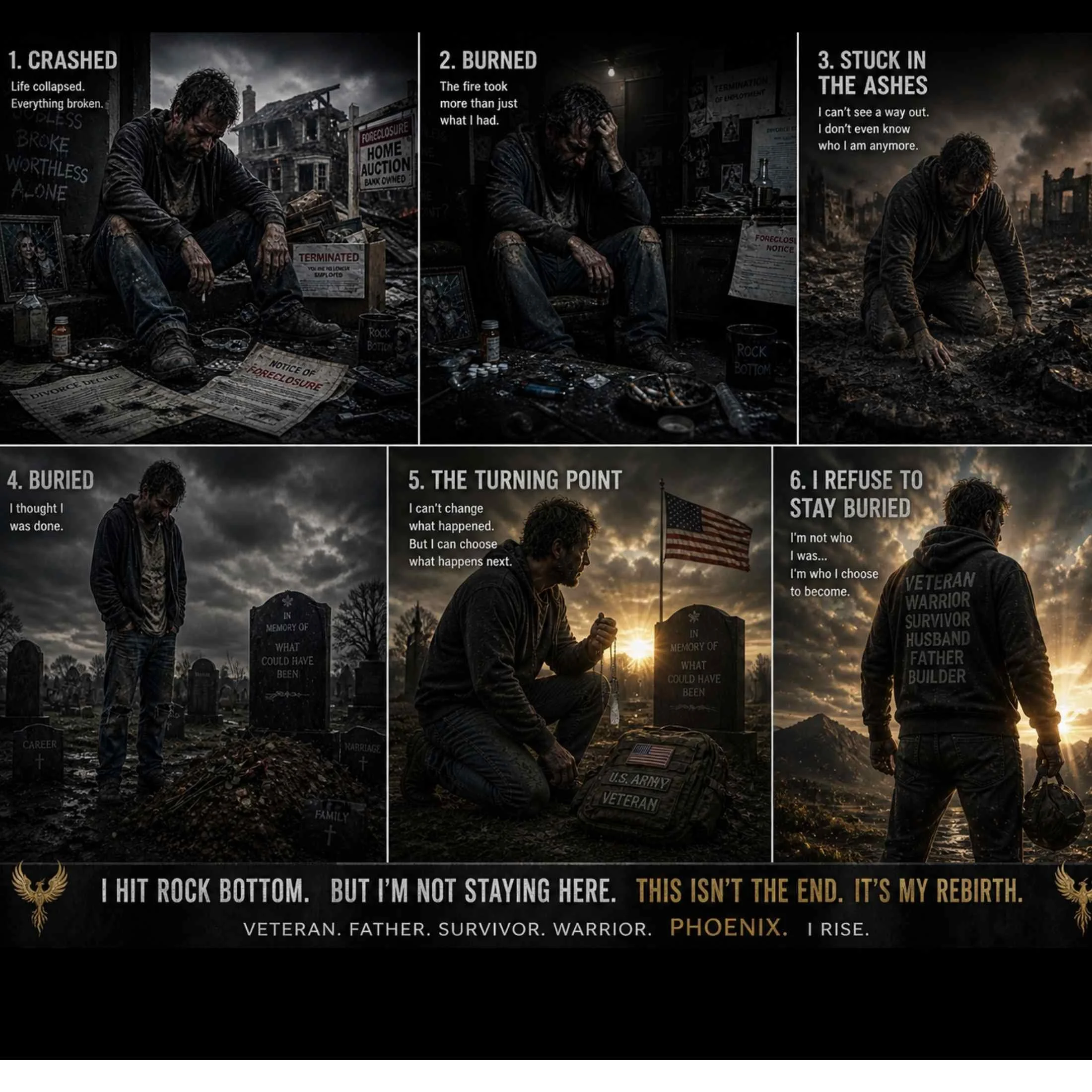
There Was a Moment Everything Broke
Not slowly.
Not over years.
Not in a way I could manage or control.
All at once.
My wife was gone.
My job was gone.
The house I worked for was slipping toward foreclosure.
And I was standing there with no plan, no direction, and a daughter watching it all unfold.
That’s not a “phase.”
That’s a collapse.
I Didn’t Have a Midlife Crisis My Life Collapsed All at Once
I Didn’t Build the Phoenix System From a Safe Distance.
I Built It From the Wreckage of My Own Life.

This is the story behind the crash, the fire, the collapse, and the reason I refuse to let broken men believe they are finished.
From the Outside, It Doesn’t Always Look Like a Crash
There’s a dangerous kind of collapse that doesn’t announce itself all at once.
No sirens.
No cinematic explosion.
No public warning.
Just pressure.
Silent, steady, soul-level pressure.
You keep functioning.
You keep working.
You keep saying the right things.
You keep playing the role.
You keep pushing.
You keep performing.
But inside, something is deteriorating.
You feel off.
Disconnected.
Angry.
Numb.
Restless.
Ashamed.
Lost.
You start doing what a lot of men do when they don’t know how to face themselves.
You bury.
You distract.
You medicate.
You perform harder.
You isolate.
You hide behind productivity, religion, sex, work, control, pride, or silence.
And for a while, it works just enough to keep the machine moving.
Until it doesn’t.
That’s the part many men never learned:
you can survive dysfunction for years before it finally collects its debt.
My Crash Wasn’t Random
What I came to understand is that midlife doesn’t create a broken man out of nowhere.
It reveals him.
It reveals the childhood wounds he never named.
The beliefs he never questioned.
The emotional illiteracy he was taught to call masculinity.
The false strength.
The father hunger.
The pressure to perform.
The fear of failure.
The buried grief.
The spiritual confusion.
The quiet self-hatred.
The inherited scripts.
My crash did not come from one bad week.
It came from years of living on top of foundations I never stopped to inspect.
Things I thought were normal weren’t normal.
Things I thought were strength were often defense.
Things I thought were discipline were sometimes fear in a nicer jacket.
Things I thought were “just the way I am” were often wounds that had learned how to speak in my voice.
That truth hit hard.
Because once you see it, you can’t unsee it.
And once you realize your life has been shaped by forces deeper than simple bad habits, you stop asking, “What’s wrong with me?”
You start asking, “What built me this way?”
That question changed my life.
The Fire Exposed More Than My Pain
Crash and burn seasons do something brutal.
They strip away the story you were telling yourself.
You can only fake being okay for so long.
You can only outrun yourself for so many years.
You can only carry unresolved grief, trauma, rage, pride, lust, shame, fear, and father wounds before they start leaking into everything.
Relationships.
Leadership.
Faith.
Purpose.
Identity.
Peace.
Self-respect.
The fire exposes it all.
It exposes who you are when the image breaks.
Who you are when the applause stops.
Who you are when the coping mechanisms fail.
Who you are when the old identity cannot carry the weight anymore.
And that is terrifying.
But it is also where truth begins.
Because the same fire that destroys the false man can become the forge that rebuilds the real one.
That is where the Phoenix System came from.
Not from hype.
Not from branding.
Not from pretending I had it all figured out.
It came from learning that a man can lose almost everything and still not be beyond redemption.
It came from discovering that ashes are not always the end of the story.
Sometimes they are the place where the real one begins.
Why I Built the Phoenix System
I built this because I know there are men walking around every day carrying a silent collapse nobody can see.
Men who are not weak.
Men who are not stupid.
Men who are not lazy.
Men who are wounded.
Programmed.
Buried under shame.
Trapped in old survival scripts.
Cut off from their own emotional lives.
Terrified of being exposed.
Terrified of staying the same.
I built this for the man who feels like he ruined too much.
The man who doesn’t recognize himself anymore.
The man who can still function in public but is coming apart in private.
The man who knows something is deeply wrong but has never had language for it.
The man who is sick of shallow advice, weak slogans, and sugar-coated nonsense.
The Phoenix System exists because men need more than inspiration.
They need understanding.
They need language.
They need structure.
They need truth.
They need a path.
They need brotherhood.
They need a way to rebuild that is honest enough for the crash they actually lived through.
This is not about polishing your image.
It’s about rebuilding your foundation.

My Background Matters — But the Fire Matters Too
I care deeply about credibility because men deserve more than empty words.
My work is shaped not only by lived experience, but also by academic training in human development, family systems, identity formation, and the long shadow childhood leaves on adult life.
I’ve spent years thinking through what breaks men, what forms men, what deforms men, and what can help rebuild them.
But here’s the truth:
Degrees can give language to pain,
yet lived fire gives weight to that language.
That’s why the Phoenix System is both personal and structured.
It is forged through lived collapse.
Studied through developmental understanding.
Built for men who need both truth and traction.
This isn’t theory floating above reality.
It is reality dragged through the forge until it became a system a broken man can actually use.
What I Believe About the Man in the Ashes
I believe a man can be humbled without being discarded.
I believe a man can face what he became without being sentenced to stay there.
I believe childhood damage explains a lot, but it does not excuse a lifetime of unconscious destruction.
I believe God does not waste fire.
I believe the crash can become a confrontation.
The confrontation can become surrender.
The surrender can become rebuilding.
The rebuilding can become purpose.
I believe men need truth more than coddling.
But I also believe many men have never once been truly seen in their pain.
And sometimes the first crack of light comes when a man realizes:
I’m not insane.
I’m not alone.
And I’m not finished.
If You’re Standing in Ashes Right Now
Maybe your crash doesn’t look exactly like mine.
Maybe yours came through divorce.
Addiction.
Shame.
Secrets.
Burnout.
Emotional shutdown.
Loss of faith.
Loss of purpose.
Loss of control.
Loss of identity.
Loss of respect.
Loss of self.
But if you know what it means to hit a wall and realize the old version of you is no longer sustainable, then brother, you are in the right place.
Not because this place will flatter you.
But because it will tell you the truth.
And the truth is this:
You may have burned.
You may have failed.
You may have wrecked things.
You may have become a version of yourself you never thought you would become.
But ashes are still material.
And God is still in the business of rebuilding what pride, pain, fear, and broken formation tried to destroy.
You do not need another fake reset.
You do not need another shallow pep talk.
You do not need another performance mask.
You need truth.
You need a path.
You need language for the fire.
You need a way forward.
That is why this exists.
This Is Where the Rebuild Starts
No man rises from the ashes alone.
When Everything Collapsed.
There was a moment… when it all hit at once.
It didn’t fall apart slowly. It collapsed all at once.
This wasn’t a crisis. This was a midlife crash.
This was the moment when everything started burning.

1. That moment The call. The silence. The realization.
2. The disheartening reality Marriage gone Job loss / instability Financial pressure Isolation
3. The physical pain. Couldn’t breathe right Chest tight Sleep wrecked Looking in the mirror and not recognizing myself…
That’s when I knew this wasn’t a phase. My life had collapsed.
And then came the part no one talks about…
Facing myself in it.
Hear Me, This Wasn’t the Moment I Crashed.
This Was the Moment I Realized
I Already Had.
The crash didn’t start that day…
It just became impossible to ignore.
It didn’t start here.
That’s the part I didn’t understand at the time.
I thought the crash was the moment everything fell apart—
when my marriage ended, when the pressure at work turned into instability, when the financial weight started closing in.But the truth?
It had been building for years.
Quietly.
Under the surface.
In the way I handled stress.
In the way I avoided hard conversations.
In the habits I justified.
In the patterns I never questioned—because they felt normal.Patterns I didn’t create…
but I sure as hell carried forward.“You don’t crash in a moment.
You crash in patterns you refuse to see.”Then life started stacking consequences.
My marriage didn’t just “get difficult.”
It broke.The kind of break that doesn’t argue…
it goes silent.Then came the pressure at work—
uncertainty, instability, the sense that what I thought was solid… wasn’t.And the financial strain followed close behind.
The kind that doesn’t just sit on paper—
it sits on your chest.Each hit felt like the problem.
But it wasn’t.
They were all signals.
I just wasn’t reading them.
“What feels like separate problems…
is often one life unraveling.”And then came the part I didn’t expect.
Not another event.
Not another loss.
Silence.
About 30 days of it.
Thirty days of sitting in the wreckage.
No clear direction.
No immediate fix.
No energy to pretend everything was fine.Just me… and what was left.
And that’s when it hit.
Not slowly.
Not intellectually.
All at once.
My life—as I knew it—was over.
Not wounded.
Not off track.
Not going through a phase.Over.
I remember sitting there thinking…
How did I not see this coming?
And the answer was brutal:
Because I wasn’t looking.
“You don’t miss the crash because it’s hidden.
You miss it because you’re used to it.”That was the moment everything became clear.
Not the crash itself… the truth of it.
I wasn’t dealing with a bad season.
I was standing in the outcome of years
of unchallenged patterns,
unchecked behaviors,
and a life I thought I was managing…but was slowly losing control of.
And right there… in the quiet, in the weight, in the ashes—
I realized something else.
I had a choice.
“Stay in the ashes… or get up and rebuild.”
No one was coming to fix it.
No reset button.
No clean explanation.
No shortcut out.Just a man, sitting in what was left of his life…
deciding what happens next.
And that decision didn’t start with rebuilding anything around me…
It started with facing the man in it.
“You don’t notice the collapse while you’re living inside it.”
AWARENESS IS THE FIRST BREAK
This was the moment everything burned.
It didn’t unravel over time.
There was no slow fade.
No warning that gave me time to prepare.
It all stacked at once.
My marriage was gone.
Not drifting—gone.
The kind of gone that leaves silence where something used to live.
My career—the thing I leaned on, the thing that was supposed to hold the line—was slipping out from under me. No stability. No direction. No sense of control.
And the pressure… it wasn’t abstract.
It was physical.
I felt it in my chest.
Tight. Heavy. Like something was sitting on me and wasn’t getting off.
Sleep wasn’t sleep anymore.
It was exhaustion mixed with anxiety.
Wake up tired. Go to bed wired. Repeat.
I remember looking in the mirror… and not recognizing the man standing there.
Face worn down.
Body soft, neglected.
Eyes carrying something I couldn’t name yet—but I knew it wasn’t good.
And underneath all of it…
was the quiet panic I didn’t want to admit:
How did my life get here?
The Hardest Part Wasn’t the Crash
It Was Facing Myself.
That moment in the ashes didn’t come with clarity.
It came with a mirror.
Not the kind you glance at and walk past.
The kind you can’t avoid.
At first, I wanted to blame everything outside of me.
The situation.
The pressure.
The people.
The timing.
And to be fair—some of it was real.
But not all of it.
Because when everything finally went quiet…
when there was no one left to perform for,
no role left to play,
no distraction strong enough to numb it—
I started to see something I didn’t want to see… Me.
“The crash doesn’t just take your life apart.
It strips away the version of you that was hiding in it.”
I saw how I avoided hard conversations.
How I shut down instead of stepping up.
How I justified things I knew weren’t right.
How I let patterns run on autopilot because they felt familiar.
Familiar didn’t mean healthy.
It just meant practiced.
I saw how I blamed stress… when it was really my response to it.
How I blamed circumstances… when it was my lack of control inside them.
How I told myself I was doing my best… when deep down, I knew I was coasting in areas that mattered most.
“You can survive for years on autopilot…
and still lose everything that matters.”
That realization didn’t come with motivation.
It came with resistance.
Because owning that truth meant something I didn’t want to accept:
I wasn’t just a victim of the crash.
I was part of the reason it happened.
And that’s the part most men never get to.
Not because they can’t…
but because they won’t stay in the mirror long enough.
“It’s easier to blame the fire…
than admit you were playing with it.”
There were moments I wanted to look away.
Moments I wanted to go back to distraction, denial, anything that made me feel less exposed.
Because the truth?
Seeing yourself clearly isn’t empowering at first.
It’s humbling.
It strips you.
It forces you to confront the gap between:
who you thought you were…
and who you actually showed up as.
And that gap?
That’s where the crash lives.
“You don’t rebuild your life by fixing the surface.
You rebuild it by confronting the man who built it.”
That’s when I understood something that changed everything:
This wasn’t just about rebuilding what I lost.
It was about rebuilding who I was.
And that realization hit even harder…
because I wasn’t the only one watching the man I had become.
And just when I thought I understood the weight of it… something made it even heavier.
I Wasn’t the Only One Living in the Ashes.
She Was Standing in the Ashes With Me.
And then it hit me in a way the crash hadn’t.
Not louder.
Not more chaotic.
Just… deeper.
My daughter.
She wasn’t living through the crash the way I was.
But she was standing in it.
Watching it.
Learning from it.
Watching how I handled pressure.
Watching how I carried myself.
Watching what I did when everything fell apart.
And that realization landed harder than anything I had lost.
Because this wasn’t just my life anymore.
It was an example.
And whether I liked it or not…
I was teaching her something.
Not through words.
Through how I lived in the ashes.
If I stayed stuck…
If I stayed angry…
If I stayed lost, checked out, disconnected, or broken…
That becomes normal to her.
That becomes expected.
That becomes the standard she carries forward.
That’s when it stopped being about survival.
Because survival would have kept me in the ashes.
This became about responsibility.
About what kind of man I was going to be
when someone I love was watching me fall apart.
That mirror didn’t just reflect me.
It reflected what my life looked like to the one person
who didn’t have a choice in any of it.
My daughter…
Didn’t ask for the instability.
Didn’t create the tension.
Didn’t deserve the version of me that was trying to hold it together… but clearly wasn’t.
And the truth I couldn’t ignore was this:
She wasn’t just seeing what I said.
She was seeing who I was.
“Your kids don’t listen to your words. They study your life.”
She saw the exhaustion.
The stress I carried into the room.
The distraction.
The weight I thought I was hiding.
Kids don’t miss that.
They absorb it.
There were moments I caught myself…
not being present,
not fully engaged,
not showing up like the man I believed I was supposed to be.
And I knew it.
Not in theory.
Not as some distant idea of “being a better father.”
But in real time.
In the way she looked at me.
In the way I responded.
In the quiet awareness that something wasn’t right.
“You don’t have to say you’re struggling.
The people closest to you already know.”
And that’s when it hit harder than anything else had.
This wasn’t just about my life anymore.
This wasn’t just about my stress, my loss, my identity.
This was about what I was modeling.
Because whether I liked it or not…
I was showing her what a man does
when his life falls apart.
“In your lowest moments… you’re still teaching.”
And I had to face a question I couldn’t avoid:
If she follows this version of me…
where does it lead her?
That question cut deeper than the crash.
Deeper than the mirror.
Because now the stakes weren’t just internal.
They were generational.
“You don’t just pass down what you teach. You pass down who you are.”
That’s when staying in the ashes stopped being an option.
Not because I felt strong.
Not because I had a plan.
But because I knew this:
If I didn’t change…
this pattern wouldn’t end with me.
And that realization led to the only decision that mattered…
I wasn’t staying there.
That Was the Moment I Drew the Line.
No sudden clarity.
No surge of confidence.
No moment where everything made sense.
What happened was quieter than that.
But heavier.
I reached a point where staying the same
felt worse than changing.
Not because I knew how to fix everything.
I didn’t.
Not because I had a plan.
I didn’t.
But because I understood something I couldn’t ignore anymore:
If I stayed in the ashes…
this would become my life.
“Rock bottom doesn’t change you.
What you decide there does.”
Honest about what I had allowed.
Honest about what I had avoided.
Honest about the fact that no one was coming to rebuild this for me.
And once you see that clearly…
you don’t get to unsee it.
There was no dramatic speech.
No big declaration.
Just a decision that locked in:
I wasn’t staying here.
“You don’t rise when you feel ready.
You rise when staying down becomes unacceptable.”
That decision didn’t fix anything overnight.
It didn’t restore what was lost.
It didn’t erase the damage.
But it did something more important:
It changed my direction.
For the first time in a long time…
I stopped reacting to my life
and started taking responsibility for it.
Small steps.
Uncomfortable ones.
Ones I didn’t always feel like taking.
But they were mine.
And they were forward.
“The rebuild doesn’t start when your life changes. It starts when you do.”
That was the pivot.
Not a perfect plan.
Not a finished version of me.
Just a man in the ashes…
who decided he wasn’t going to die there.
And that decision, imperfect as it was, became the foundation for everything that came next.
I Didn’t Set Out to Build a System.
I Was Trying to Rebuild My Life.
This Didn’t Start as a System.
It Started as Survival.
The Fire Didn’t Just Break Me.
It Forced Me to Build Something Better.
What came next didn’t start as a plan.
There was no outline.
No framework.
No idea that any of this would become something I’d share.
I was just trying to figure out how not to end up back there.
Because once you’ve seen your life collapse—
once you’ve sat in the ashes long enough to understand what got you there—
you don’t just want relief.
You want something that holds.
“Pain will wake you up.
But it won’t rebuild you.”
So I started paying attention.
Not to theory.
Not to quick fixes.
To patterns.
What broke.
What I ignored.
What I justified.
What I avoided.
And more importantly—
what actually moved me forward.
Small things at first.
Showing up when I didn’t feel like it
Facing conversations I used to avoid
Taking responsibility instead of deflecting it
Rebuilding discipline in areas I had let slide
None of it felt impressive.
All of it felt necessary.
“You don’t rebuild your life with big moves.
You rebuild it with consistent ones.”
And over time, something started to happen.
Not overnight.
Not cleanly.
Not perfectly.
But clearly.
I could see the difference between:
what kept me stuck
and what actually rebuilt me
I could see the stages.
The patterns.
The order things had to happen in.
Not because I studied them…
but because I lived them.
“When you’ve lived the collapse…
you stop guessing what it takes to rebuild.”
And that’s when it shifted.
This wasn’t just about getting through a hard season anymore.
This was about building a life that wouldn’t collapse the same way twice.
That required more than effort.
It required structure.
Not rigid.
Not complicated.
But real.
Something that addressed:
how I think
how I show up
how I handle pressure
how I lead myself and the people around me
That’s what became the Phoenix System.
Not something I invented to sell.
Something I built…
because I needed it.
“This system wasn’t created in comfort.
It was forged in the middle of collapse.”
And if you’re here… if something in your life isn’t holding the way it used to—
this is where your rebuild starts.
This Was Not a Midlife Crisis.
This Was a Midlife Crash.
There’s a moment in a man’s collapse where everything becomes clear.
Not better.
Not easier.
Clear.
After the crash…
After the mirror…
After realizing I wasn’t the only one standing in the ashes…
I couldn’t call this what everyone else calls it.
This wasn’t stress.
This wasn’t burnout.
This wasn’t a phase.
This was a midlife crash.
Because a crisis is something you manage.
You ride it out.
You adjust.
You cope.
A crash doesn’t give you that option.
A crash exposes what was already broken.
It strips away what wasn’t real.
It collapses what couldn’t hold.
It forces you to face what you’ve been avoiding.
And in that moment…
there are only two paths:
Stay in the ashes.
Or figure out how to rise from them.
No middle ground.
No pretending.
No slow drift back to comfort.
Because if I didn’t change…
I wasn’t rebuilding my life.
I was rebuilding the same collapse.
That’s when it shifted.
Not because I felt strong.
Not because I had a plan.
But because I understood the cost of staying the same.
And that cost was too high.
“A crisis passes. A crash demands a rebuild.”
“If you don’t rebuild… you repeat.”
- NO REBUILD — SAME COLLAPSE
- ASHES OR ASCENT — PICK ONE
- REPEAT OR RISE
That’s where the rebuild began.
Not with motivation… but with truth I couldn’t ignore.
I burned.
I broke.
I rebuilt.
I’ll show you how.
This isn’t theory.
This is built from the fire.
This Wasn’t About a System.
This Was Solely About My Survival.
There was no blueprint.
No plan to build something others would follow.
I was just trying to figure out how not to stay where I was.
Not from books alone.
Not from theory untouched by reality.
Not from watching from the outside.
From breaking…
understanding…
and rebuilding in a way that doesn’t collapse the same way twice.
What came next didn’t start as a plan.
There was no outline.
No framework.
No idea that any of this would become something I’d share.
I was just trying to figure out how not to end up back there.
Because once you’ve seen your life collapse—
once you’ve sat in the ashes long enough to understand what got you there—
you don’t just want relief.
You want something that holds.
“Pain will wake you up.
But it won’t rebuild you.”
So I started paying attention.
Not to theory.
Not to quick fixes.
To patterns.
What broke.
What I ignored.
What I justified.
What I avoided.
And more importantly—
what actually moved me forward.
Small things at first.
- Showing up when I didn’t feel like it
- Facing conversations I used to avoid
- Taking responsibility instead of deflecting it
- Rebuilding discipline in areas I had let slide
None of it felt impressive.
All of it felt necessary.
“You don’t rebuild your life with big moves.
You rebuild it with consistent ones.”
And over time, something started to happen.
Not overnight.
Not cleanly.
Not perfectly.
But clearly.
I could see the difference between:
- what kept me stuck
=and what actually rebuilt me
I could see the stages.
The patterns.
The order things had to happen in.
Not because I studied them…
but because I lived them.
“When you’ve lived the collapse…
you stop guessing what it takes to rebuild.”
And that’s when it shifted.
This wasn’t just about getting through a hard season anymore.
This was about building a life that wouldn’t collapse the same way twice.
That required more than effort.
It required structure.
Not rigid.
Not complicated.
But real.
Something that addressed:
- how I think
- how I show up
- how I handle pressure
- how I lead myself and the people around me.
That’s what became the Phoenix System.
Not something I invented to sell.
Something I built…
because I needed it.
“This system wasn’t created in comfort.
It was forged in the middle of collapse.”
And if you’re here… if something in your life isn’t holding the way it used too. This is where your rebuild starts.
“I didn’t design this. I lived it.”
BUILT FROM SURVIVAL — NOT THEORY
You Don’t Need a Perfect Plan.
You Need a Starting Point.
If you’ve made it this far… there’s a reason.
Something in your life isn’t holding the way it used to.
Maybe it hasn’t collapsed completely.
Maybe it already has.
But you feel it.
The pressure.
The disconnect.
The quiet awareness that something isn’t right… even if you haven’t said it out loud yet.
And here’s the truth most men try to skip:
You can’t rebuild what you won’t face.
“Clarity comes before change.
Whether you like what you see… or not.”
That’s why the first step isn’t fixing everything.
It’s seeing where you actually stand.
Not where you think you are.
Not where you want to be.
Where you really are.
Because most men don’t fail from lack of effort.
They fail from building on a foundation they’ve never fully examined.
“You don’t rebuild your life by guessing.
You rebuild it by getting honest about the damage.”
That’s where this starts.
Not with a full system.
Not with a 10-step plan.
With a simple, honest look at your life right now.
What’s solid.
What’s slipping.
What’s already broken… whether you’ve admitted it or not.
That’s why I built the Crash Audit.
Not as a test.
Not as a gimmick.
As a way to help you see clearly — so you don’t waste another year trying to fix the wrong things.
“You can stay in the dark about your life…
or you can finally see it for what it is.”
If you’re ready to be honest about where you stand — start there.
You don’t fix this by going back.
You rebuild by becoming someone stronger than what collapsed.
No hype. No guesswork.
Just a clear look at where your life stands right now.
If you’re ready to be honest about where you stand - start there.
Begin rebuilding with clarity and structure.
Take the Crash Audit now—don’t guess where you stand.
See the full path from crash to rebuild.
No man rises from the ashes alone.