
THE PHOENIX SYSTEM - THE PHOENIX PATH
CRASH
FIRE
FORGE
RISE
The path from midlife collapse to a different way of living.
THE RISE IS NOT ARRIVAL. THE FORGE NEVER CLOSES.

Brother, something has happened.
Maybe your marriage has collapsed.
Maybe your career is gone.
Maybe the family no longer trusts you.
Maybe your health is deteriorating, your faith has weakened, or the identity you spent decades building no longer makes sense.
Or maybe nothing has collapsed yet—but you can feel the foundation beginning to crack.
You know something must change.
The question is no longer simply how to get your old life back.
The question is what kind of man you must become to carry the life that remains.
The Phoenix System gives that rebuilding journey a name.
THE PHOENIX PATH.
And it begins with telling the truth about where you stand.
EVERY REBUILD FOLLOWS A PATH
No man wakes up one morning completely rebuilt.
No man rises from the ashes in a single moment.
Transformation is not an event.
It is a process.
A journey through collapse, exposure, rebuilding, and the beginning of a different life.
The Phoenix System identifies four foundational movements in that journey.
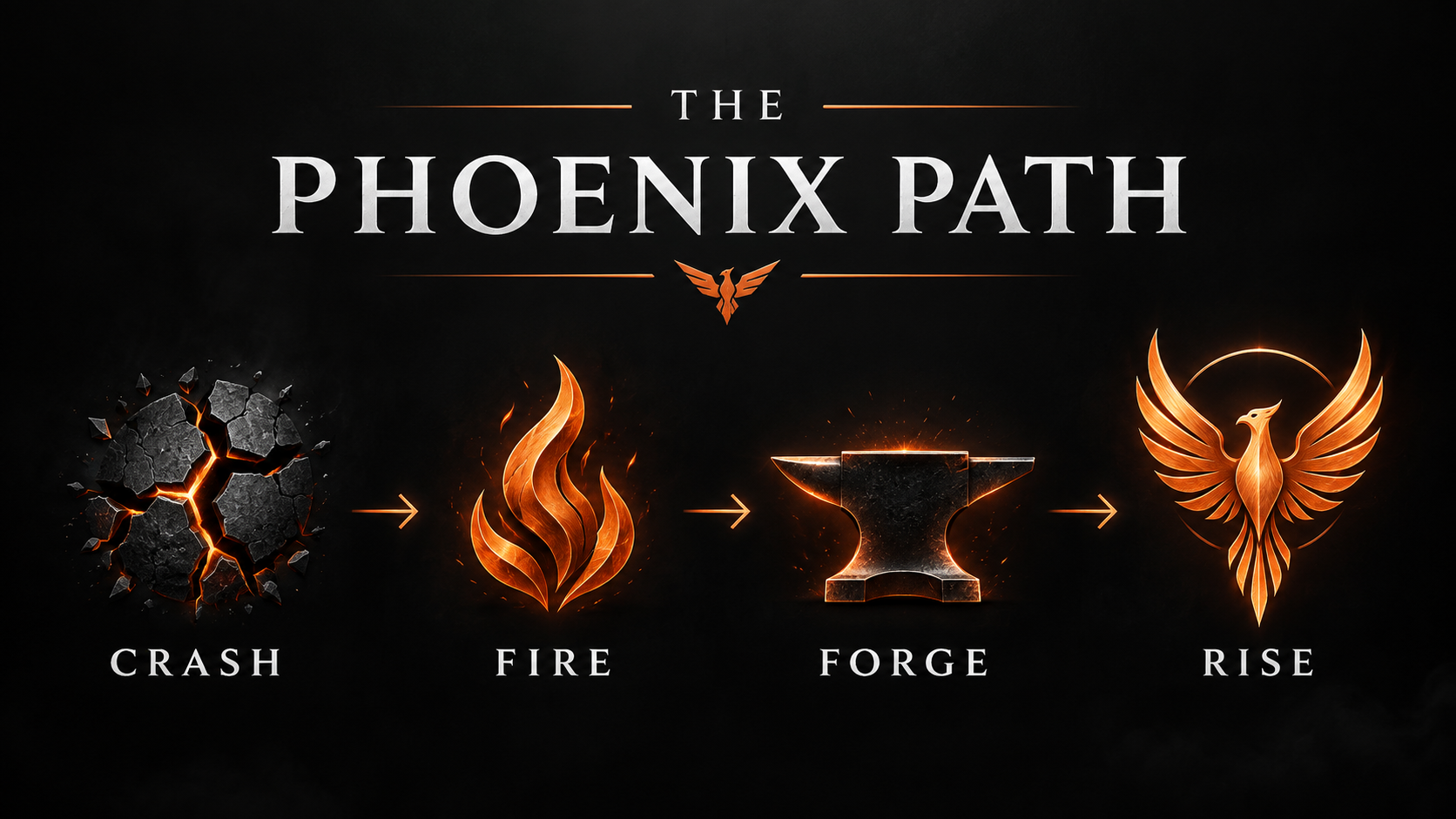
The Crash reveals that something can no longer continue.
The Fire exposes what must be faced.
The Forge is where the man begins rebuilding.
The Rise is where a different man begins living.
These movements provide direction, but they are not a rigid timetable. A man may be rebuilding one part of his life while still confronting the Fire in another.
He may rise and later discover something else that needs to be reforged.
The path is not about racing toward a finish line.
It is about becoming a man who no longer has to live under the control of his old operating system.
MOVEMENT 01
CRASH
THE STRUCTURE FAILS.

The life you built can no longer carry the weight placed upon it.
The crash is not always a single event
Sometimes the crash happens in one devastating moment.
A marriage ends.
A job disappears.
A doctor delivers news a man never expected to hear.
Someone he loves dies.
The future he thought he understood suddenly looks nothing like the life in front of him.
But sometimes the crash happens slowly.
A man spends years ignoring the distance growing inside his marriage.
His work consumes his identity.
His health deteriorates while he tells himself he will deal with it later.
His relationships become increasingly strained.
His habits become harder to control.
He may continue functioning outwardly while something inside him is already collapsing.
Then one day, the structure fails.
Not every crash is caused by the man's own decisions. Illness, bereavement, betrayal, economic changes, and circumstances beyond his control can radically alter a life.
But whatever caused the collapse, he must eventually confront an unavoidable question:
What am I going to do with the life that remains?
THE CRASH ATTACKS MORE THAN YOUR CIRCUMSTANCES
A man may lose his job and discover that he has no idea who he is without his career.
He may lose his marriage and realize that he has spent decades defining himself through being a husband.
He may experience physical decline and begin questioning his masculinity, usefulness, or independence.
He may suffer a loss that shakes his understanding of God.
The crash can expose how closely a man's identity has become attached to things that were never guaranteed to remain.
His income.
His marriage.
His authority.
His possessions.
His physical strength.
His status.
His ability to control the future.
The Phoenix System does not begin by telling a crashed man to simply be stronger.
It begins by helping him understand what happened, what remains, and what must be faced.
YOUR FIRST RESPONSIBILITY IS NOT TO REBUILD EVERYTHING TODAY
When a man's life collapses, he may feel desperate to fix everything immediately.
Save the marriage.
Recover the income.
Find another relationship.
Make the pain stop.
Prove he is still the man he used to be.
But urgency can lead him to repeat the same patterns that need examination.
The first responsibility is to establish enough stability to begin facing the truth.
Address immediate safety concerns.
Seek appropriate help when the situation requires it.
Protect essential responsibilities.
Identify what is within your control and what is not.
And resist the temptation to make every major life decision while overwhelmed by the immediate impact of the crash.
You do not have to solve the rest of your life today.
You do need to begin telling the truth about where you stand.
THE CRASH INVENTORY
Brother, examine your foundation.
Before a man can begin rebuilding, he needs an honest understanding of what has happened, what remains, and where he may need help.
This inventory is not about assigning blame for everything that went wrong.
It is about identifying the damage, recognizing your responsibilities, and establishing where the rebuilding must begin.
Take your time. Answer honestly. You do not need to solve everything today.
Use these questions to identify what has collapsed, what remains intact, and where you may need support.
1. What has actually collapsed in my life?
2. What am I afraid of losing next?
3. Which parts of my identity were attached to what I lost?
4. What responsibilities require my immediate attention?
5. Which circumstances were beyond my control?
6. What decisions, habits, or patterns of my own need honest examination?
7. What strengths, relationships, resources, and sources of support remain?
8. What help do I need before I can begin rebuilding?
YOU'VE COMPLETED THE CRASH INVENTORY. NOW WHAT?
Brother, completing this inventory is not the end of the exercise.
It is the beginning of understanding where you stand.
Your answers may reveal circumstances beyond your control, responsibilities that require immediate attention, patterns you need to examine, and areas of your life where you need help.
Do not try to fix everything at once.
Instead, review your answers and begin identifying what matters most right now.
YOUR NEXT STEPS
01
IDENTIFY WHAT REQUIRES IMMEDIATE ATTENTION.
Is there a safety concern, medical need, financial emergency, housing problem, or family responsibility that cannot wait?
Address urgent needs first. Seek appropriate professional assistance where necessary.
02
SEPARATE WHAT HAPPENED TO YOU FROM WHAT YOU ARE RESPONSIBLE FOR.
Not everything that collapsed was within your control.
But some decisions, habits, and behaviors may require honest examination.
Recognize the difference without blaming yourself for circumstances you did not cause or excusing choices that were yours.
03
IDENTIFY WHAT REMAINS.
What strengths, relationships, resources, responsibilities, and sources of support are still present in your life?
Your inventory should identify more than what you lost. It should help you recognize what you still have to work with.
04
CHOOSE ONE PRACTICAL NEXT STEP.
Identify one action you can take toward greater stability.
Make an appointment. Have a necessary conversation. Address an overdue responsibility. Ask someone trustworthy for help.
Start with what is realistic and within your control.
05
KEEP YOUR INVENTORY. RETURN TO IT.
Your understanding of the crash may change as you move through the Fire and Forge.
Keep your completed worksheet somewhere private and secure. Review it periodically, and update it when you recognize something important that you previously overlooked.
YOUR INVENTORY IS A STARTING POINT, NOT A VERDICT.
The purpose of this exercise is not to convince you that your life is ruined.
It is to help you recognize where you stand so you can begin making informed decisions about what comes next.
Some of your answers may be difficult to face. Others may reveal strengths and opportunities you had forgotten.
You do not have to share your completed inventory with the Phoenix System or anyone else.
But if your answers reveal a serious problem, do not allow privacy to become isolation. Consider discussing the relevant concerns with a qualified professional, pastor, or trusted person who can provide appropriate support.
You have examined the wreckage. Now you can begin confronting what the crash has revealed.
THE CRASH IS NOT YOUR FINAL IDENTITY
You may have lost something that mattered deeply.
You may have made decisions that caused real damage.
You may be carrying grief, anger, shame, or uncertainty.
But the crash itself does not determine the entirety of the man you can become.
You still have responsibilities.
You still have choices.
You still have a life that must be lived.
And you do not have to navigate the rebuilding process alone.
THE CRASH DECLARATION
I will tell the truth about what has collapsed. I will distinguish what happened to me from the choices I made. I will accept responsibility for what is mine, seek help where it is needed, and begin rebuilding from the foundation rather than pretending the damage is not there.
THE TRANSITION INTO FIRE
The Crash forces a man to confront what happened.
The Fire asks him to confront something more difficult.
What was happening inside the man before everything fell apart?
Not everything revealed by the crash caused it.
Not every wound is a moral failure.
And not every man enters the Fire carrying the same struggles.
But the rebuilding process cannot move forward while a man refuses to examine the beliefs, habits, fears, defenses, and unresolved pain that continue shaping his life.
The next movement is not about punishing the man for what happened.
It is about bringing what needs attention into the light.
MOVEMENT 02
FIRE
THE HIDDEN MAN IS EXPOSED.
You cannot rebuild what you refuse to examine.
THE FIRE BEGINS WHEN THE HIDING STOPS
Brother, the Crash may have shattered the life you spent decades building.
But the wreckage is not the whole story.
The collapse may have exposed something beneath the surface.
Something you carried long before your marriage began to fail.
Long before your career ended.
Long before your health deteriorated.
Long before you found yourself standing in the ashes, wondering how your life became what it is today.
The beliefs you accepted without questioning.
The wounds you learned to conceal.
The habits you developed to survive.
The emotions you never learned to express.
The responsibilities you avoided.
The behavior you defended.
The relationship with God you neglected.
And the man you learned to become because you believed there was no other way to live.
The Fire is where those things can no longer remain hidden.
THE CRASH EXPOSES WHAT HAPPENED TO YOUR LIFE.
THE FIRE ASKS WHAT WAS HAPPENING INSIDE THE MAN WHO WAS LIVING IT.
The answer may be uncomfortable.
It may also become the beginning of genuine change.
THE FIRE DIDN'T START WITH YOU
Before you begin examining your failures, we need to recognize something important.
You did not enter adulthood as a fully formed man.
You were shaped by people, experiences, expectations, and circumstances that began influencing you long before you understood what was happening.
Your parents.
Your grandparents.
Your childhood home.
Your teachers.
Your coaches.
Your friendships.
Your culture.
Your understanding of masculinity.
Your early experiences with faith.
Your successes.
Your failures.
Your losses.
And the things you learned to do to protect yourself from rejection, humiliation, fear, or pain.
Some of those influences helped build the man you became.
Others may have left weaknesses, misunderstandings, emotional wounds, or patterns of behavior that followed you into adulthood.
You may have learned that a man never cries.
That asking for help demonstrates weakness.
That providing financially is the only meaningful measure of fatherhood.
That love must be earned through achievement.
That admitting wrongdoing means surrendering authority.
That sexual attention proves your worth.
That being needed is the same thing as being loved.
Or that maintaining the appearance of a successful life matters more than being truthful about what is happening inside it.
You may have carried some of those beliefs for fifty years without ever questioning them.
The Fire asks you to examine what you inherited, what you learned, what you chose, and what you continued to carry.
Understanding where a pattern originated does not automatically excuse what you did with it.
But it can help you recognize what needs to change.
THE ORIGIN QUESTION
What did I learn about being a man that I have never seriously examined?
EXPLORE THE FIRE DIDN'T START WITH YOU →
THE MAN YOU LEARNED TO BE
A man does not always develop his identity through conscious decisions.
Sometimes he becomes the person his circumstances required him to be.
The strong one.
The provider.
The achiever.
The protector.
The problem solver.
The man who never needs anything.
The man who can handle everything.
The man who keeps everyone else happy.
The man who refuses to let anyone see his fear.
Some of those roles carry legitimate responsibilities.
Providing for a family matters.
Protecting the vulnerable matters.
Working diligently matters.
Being dependable matters.
But what happens when a role becomes the entirety of a man's identity?
What happens when the provider loses his career?
When the protector can no longer protect someone he loves?
When the husband loses his marriage?
When the strong man develops a serious physical limitation?
When the man who has always been needed finds himself alone?
He may discover that he never learned who he was apart from what he did for other people.
And when those roles collapse, his sense of identity collapses with them.
The Fire reveals the difference between the roles you performed and the man you became while performing them.
You are responsible for examining that difference.
Not so you can abandon legitimate responsibilities.
But so your identity is no longer entirely dependent on circumstances that can change.
WHAT HAS THE FIRE EXPOSED?
The Fire does not expose the same things in every man.
One man may discover that unresolved grief has controlled his relationships.
Another may recognize that his need for approval has dictated his decisions.
Another may confront anger, infidelity, addiction, financial irresponsibility, emotional withdrawal, or spiritual neglect.
Another may have been harmed by circumstances he did not cause and discover that fear, distrust, or isolation now prevents him from seeking help and rebuilding.
A man can also discover strengths that survived the collapse.
Courage.
Perseverance.
Love.
Faith.
Commitment.
The willingness to change.
The Fire is not only about discovering what is wrong.
It is about becoming more truthful about the whole man.
THE FIRE REVEALS WHAT WAS ALREADY THERE.
Some things need to be surrendered.
Some things need to be healed.
Some things need to be learned.
Some things need to be strengthened.
And some things need to be left behind.
THE JUSTIFICATION TRAP
There is a moment in the Fire when a man begins to recognize a pattern he does not want to admit.
He sees what he did.
He recognizes the damage.
He knows something needs to change.
And almost immediately, he begins explaining why his behavior was understandable.
Why he had no choice.
Why someone else made him do it.
Why the circumstances were different.
Why his intentions should matter more than the consequences.
Why he deserves an exception.
Brother, an explanation is not always an excuse.
Your childhood may help explain why you struggle with trust.
Your losses may help explain why you fear abandonment.
Your upbringing may help explain why you have difficulty expressing emotion.
Your circumstances may help explain why you developed certain ways of coping.
Those explanations can matter.
But understanding why you developed a pattern does not mean every action that follows from it is acceptable.
The Justification Trap begins when a man uses an explanation to avoid responsibility for what he can now recognize and change.
He may say:
"I know I hurt her, but she never appreciated me."
"I know I lied, but telling the truth would have destroyed everything."
"I know I have an anger problem, but people keep pushing me."
"I know I need help, but that's just not who I am."
"I know I should apologize, but they were wrong too."
The Fire challenges him to separate understanding from justification.
You can acknowledge what happened to you without using it to excuse what you do to others.
And you can accept responsibility for your actions without assuming responsibility for every painful event in your life.
That distinction is essential to genuine rebuilding.
THE JUSTIFICATION QUESTION
What behavior am I continuing to defend even though I recognize that it is damaging my life or the people around me?
EXPLORE - THE JUSTIFICATION TRAP →
THE FIRE EXPOSES THE DROSS
In metalworking, dross is unwanted material that can separate from molten metal during processing.
Within the Phoenix System, we use dross as a metaphor for the beliefs, habits, defenses, and destructive patterns that a man recognizes he should no longer carry.
Not every part of your history is dross.
Your grief is not automatically dross.
Your scars are not automatically dross.
Your need for love, belonging, connection, or help is not dross.
And the fact that you experienced a devastating crash does not make you defective.
But the Fire may reveal patterns that have become harmful.
Pride that prevents repentance.
Anger that harms relationships.
Dishonesty that destroys trust.
Self-medication that creates additional problems.
A need for control that leaves others afraid to speak.
Emotional withdrawal that prevents genuine intimacy.
A habit of placing responsibility for your choices entirely on other people.
A refusal to seek help because you are determined to appear invulnerable.
These patterns may have protected you, rewarded you, or helped you survive at an earlier point in life.
But that does not mean they belong in the life you are now rebuilding.
The Fire reveals the dross. The Forge is where you begin the work of removing it.
THE DROSS QUESTION
What am I still carrying that I know cannot continue into the second half of my life?
REPENTANCE IS NOT SELF-DESTRUCTION
Some men encounter the Fire and begin taking responsibility for the first time.
Others become trapped in shame.
They look at the damage in their lives and conclude that they themselves are beyond repair.
They confuse acknowledging wrongdoing with condemning their entire existence.
They believe they must continually punish themselves to demonstrate that they are sorry.
But there is an important difference between repentance and self-destruction.
Repentance calls a man to acknowledge wrongdoing, turn away from it, accept appropriate consequences, seek forgiveness, make amends where possible, and begin living differently.
Self-destruction leaves him trapped in the belief that nothing he does can ever be enough.
Within the Christian foundation of the Phoenix System, repentance is not a demand that a man earn God's grace through endless self-punishment.
It is a call to turn toward God, acknowledge the truth, and begin living in accordance with that surrender.
Your past must be faced. It does not have to become the only identity you are permitted to have.
You may have caused real harm.
Some consequences may remain.
Some relationships may never be restored.
But continuing to destroy yourself will not automatically repair the damage.
Your responsibility is to become a man who no longer repeats the behaviors that brought harm to himself or others.
And to seek appropriate support when shame, depression, compulsive behavior, or other difficulties make that work hard to undertake alone.
THE FIRE INVENTORY
BROTHER, EXAMINE THE MAN BENEATH THE WRECKAGE.
The Crash Inventory helped you identify what happened to your life.
The Fire Inventory asks you to examine the beliefs, habits, defenses, and unresolved experiences that may still be shaping your decisions.
Do not approach these questions as a trial in which you must prove that everything was your fault.
Approach them as an opportunity to recognize what is true.
EIGHT QUESTIONS FOR THE FIRE
1. What beliefs about myself, masculinity, success, love, or responsibility have shaped the way I live?
Which of those beliefs still serve me, and which need to be reconsidered?
2. What childhood experiences or earlier relationships may still influence how I respond to people and difficult situations?
What have I learned about myself through those experiences?
3. What emotions do I regularly avoid, suppress, or express in ways that create problems?
How do I respond to fear, rejection, anger, grief, shame, or vulnerability?
4. What habits or coping behaviors have become harmful to my health, relationships, responsibilities, or spiritual life?
What needs further examination or professional support?
5. What actions or decisions am I still justifying even though I recognize that they caused harm?
What responsibility belongs to me?
6. What grief, loss, disappointment, or unresolved pain am I carrying into the second half of my life?
Where do I need support, acceptance, or healing rather than blame?
7. What does my present relationship with God look like when I examine it honestly?
Where am I resisting surrender, avoiding truth, or seeking greater spiritual understanding?
8. What strengths should I preserve, and what beliefs, habits, or behaviors can no longer come with me?
What might the next stage of rebuilding require?
YOU'VE COMPLETED THE FIRE INVENTORY. NOW WHAT?
Do not attempt to change everything on your list at once.
Review your answers.
Look for recurring patterns.
Notice which areas may require greater understanding, support, or immediate attention.
Distinguish experiences that harmed you from behaviors for which you must take responsibility.
Identify the strengths you want to preserve.
Then choose one issue that needs honest attention and begin considering what practical rebuilding would look like.
Some matters may call for a difficult conversation.
Others may call for repentance, learning a new skill, changing a habit, or seeking qualified professional care.
If examining painful experiences becomes overwhelming, you can stop the exercise and return to it with appropriate support. You do not need to relive every painful event in order to begin rebuilding.
Keep your inventory private and secure.
You do not have to submit it to the Phoenix System or disclose your most personal experiences publicly.
The purpose is not to create a permanent record of everything wrong with you.
The purpose is to help you recognize what needs to change and prepare for the work of the Forge.
THE FIRE IS NOT YOUR FINAL DESTINATION
Brother, the Fire may reveal things you wish you had confronted years ago.
You may discover that you have been living under beliefs you never consciously chose.
You may recognize behaviors that harmed people you love.
You may come face-to-face with grief you have been avoiding.
You may realize that the man you spent decades defending is no longer the man you want to be.
But recognizing these things is not the same as changing them.
And spending the rest of your life examining your past will not, by itself, create the future you want to live.
THE FIRE REVEALS WHAT MUST BE FACED. THE FORGE IS WHERE YOU BEGIN DOING SOMETHING ABOUT IT.
You do not have to understand every influence, resolve every wound, or uncover every hidden pattern before taking the first step toward meaningful change.
You do need to become willing to tell the truth.
To accept responsibility for what belongs to you.
To seek help where it is needed.
To surrender what you have been unwilling to release.
And to begin the work of becoming a different man.
THE FIRE DECLARATION
I WILL NO LONGER DEFEND WHAT I KNOW MUST CHANGE.
I will examine the beliefs, wounds, habits, and behaviors that have shaped my life. I will take responsibility for what is mine without blaming myself for what I did not cause. I will seek truth rather than excuses, help rather than isolation, and God's guidance rather than relying only on my own understanding. I will preserve what is good, confront what is harmful, and begin preparing for the work of the Forge.
THE TRANSITION INTO THE FORGE
The Crash revealed what happened to your life.
The Fire began revealing what was happening within the man who lived it.
Now another question stands before you:
What are you going to do with what you have discovered?
You cannot change your childhood.
You cannot undo every decision.
You cannot guarantee that every relationship will be restored.
And you cannot return to the first half of your life and begin again.
But you can begin learning what you were never taught.
You can confront destructive patterns.
You can develop new ways of thinking, communicating, and responding.
You can strengthen your body.
You can take responsibility for your choices.
You can deepen your relationship with God.
And you can begin building the man who will carry the years that remain.
The Fire has done its work of exposure.
Now it is time to put that truth to work.
MOVEMENT 03
FORGE
THE MAN BEGINS REBUILDING.
Recognition is not transformation. The Forge is where truth becomes action.
THE FORGE BEGINS WITH A DECISION
Brother, you have examined the wreckage.
You have begun confronting what the Fire exposed.
Perhaps you now understand that the crash did not begin on the day everything collapsed.
Perhaps you recognize beliefs you inherited, habits you developed, responsibilities you avoided, or emotional wounds you never learned how to address.
You may also have recognized strengths that survived the crash.
But understanding what happened is not the same as changing how you live.
You can spend years examining your past while continuing to make the same choices in the present.
You can acknowledge a destructive habit without changing it.
You can recognize that a relationship needs repair while refusing to communicate differently.
You can understand why you fear rejection while continuing to push people away.
You can believe that God is calling you toward a different life while continuing to resist the changes that life requires.
THE FORGE BEGINS WHEN YOU STOP DEFENDING THE OLD WAY OF LIVING AND START PARTICIPATING IN THE REBUILD.
You do not have to become a different man overnight.
But you do have to begin.
YOU CANNOT REBUILD A LIFE ON THE SAME FAILED FOUNDATION
Imagine a man whose house has suffered severe structural damage.
The walls are cracked.
The supporting beams have failed.
The foundation is unstable.
Would he begin rebuilding by applying fresh paint?
Would he replace the furniture while ignoring the damaged structure?
Would he make the outside look respectable and hope nobody notices what remains underneath?
Of course not.
Yet that is how some men approach rebuilding their lives.
They find another relationship without examining the patterns that damaged the previous one.
They return to work without reconsidering an identity built entirely around achievement.
They improve their appearance while continuing to neglect their emotional health.
They begin attending church while avoiding the difficult work of repentance and reconciliation.
They tell everyone they have changed while continuing to make the same decisions.
The Forge asks a different question:
What must change beneath the surface so the man can begin living differently?
Not everything that collapsed was caused by a defective foundation. A man may have experienced devastating losses through circumstances beyond his control.
But even then, rebuilding may require new strengths, skills, support, and ways of living.
The purpose is not to declare that everything about the old man was wrong.
It is to preserve what was good, confront what was harmful, and deliberately build what the second half requires.
GOD IS THE ARCHITECT. CHRIST IS THE FOUNDATION.
The Phoenix System is a Christ-centered rebuilding framework.
That means the Forge is not merely a program of personal discipline, stronger habits, or improved performance.
Those things may be important, but they are not substitutes for a man's relationship with God.
Within the Phoenix System, the rebuilding of the whole man includes surrendering his life to God, examining his beliefs and conduct in light of Scripture, and seeking to grow in obedience, humility, love, and service.
The man does not become his own savior.
He does not earn God's acceptance by completing a series of exercises.
And the Phoenix System does not claim to replace the Church, Scripture, pastoral care, or the work of the Holy Spirit.
The Forge provides a practical framework for examining and rebuilding a man's life under Christian principles.
THE SURRENDER QUESTION
Am I asking God to bless the life I am determined to control, or am I willing to surrender the direction of my life to Him?
Surrender does not remove the need for action.
A man who recognizes that he has harmed a relationship may still need to apologize, change his behavior, and accept the other person's freedom to decide whether reconciliation is possible.
A man struggling with addiction may need professional treatment, accountability, and sustained support.
A man facing financial collapse may need practical assistance, a realistic budget, and difficult decisions about his responsibilities.
Faith and responsible action are not competing parts of the rebuilding process.
The Forge is where a man's convictions begin becoming visible in how he lives.
THE WHOLE MAN GOES INTO THE FORGE
The Phoenix System does not limit rebuilding to the area that collapsed most visibly.
A man may have lost his marriage, but his communication skills, emotional patterns, financial decisions, physical condition, and spiritual life may also need attention.
Another man may have lost his career while maintaining healthy relationships and a strong faith.
Every man's rebuilding needs will be different.
The Forge examines five interconnected dimensions of his life.
MIND
Rebuilding how you think and respond
Examine inherited beliefs, identity, emotional patterns, unresolved experiences, and automatic reactions.
Learn to distinguish facts from assumptions, recognize harmful thought patterns, communicate emotions constructively, and seek qualified support when psychological difficulties require it.
BODY
Taking responsibility for the body you have now
Examine physical health, strength, mobility, sleep, nutrition, medical needs, and the effects of aging.
The objective is not to recover a younger body. It is to care for your present body and develop the capacity to participate in the life ahead.
SPIRIT
Deepening your relationship with God
Examine your faith, understanding of Scripture, prayer life, repentance, obedience, service, and willingness to surrender.
Recognize the difference between maintaining a religious appearance and pursuing genuine spiritual growth.
RELATIONSHIPS
Learning to love, communicate, and take responsibility
Examine listening skills, trust, conflict, boundaries, marriage, fatherhood, friendship, and accountability.
Identify relationships that may be repaired, responsibilities that must be addressed, and situations where healthy distance or professional support may be necessary.
PURPOSE
Building a life worth intentionally living
Examine how you use your time, abilities, resources, and experience.
Consider your responsibilities, work, service, relationships, spiritual calling, and what you want the remaining years of your life to stand for.
These five dimensions are not five independent projects.
They influence one another.
A man who improves his physical health may gain the energy to participate more fully in relationships.
A man who learns to communicate may discover new opportunities for reconciliation.
A man who confronts dishonesty may begin rebuilding trust.
A man who develops greater spiritual discipline may reconsider how he uses his time and resources.
The whole man goes into the Forge because the whole man must learn how to live differently.
THE FIVE REFORGINGS
The five dimensions identify the areas of life that may require rebuilding.
But how does a man begin the actual work?
The Phoenix System organizes that work through five practical movements within the Forge.
THE FIVE REFORGINGS
01
CONFRONT THE TRUTH
Identify what needs to change without denial, exaggeration, or self-condemnation.
02
SURRENDER WHAT CANNOT CONTINUE
Recognize the beliefs, habits, behaviors, and attempts at control that must be released.
03
REBUILD WHAT IS MISSING OR DAMAGED
Learn necessary skills, repair what can be repaired, establish healthier practices, and seek appropriate support.
04
PRACTICE THE NEW WAY OF LIVING
Turn insight into consistent action through discipline, repetition, accountability, and responsible choices.
05
CONTINUE THE REFORGING
Reassess your progress, respond to new challenges, and remain willing to grow as life changes.
A man may need to revisit any of these movements as he grows.
He may recognize another harmful pattern after months of progress.
He may discover that an old coping strategy is no longer serving him.
He may need to learn a new skill as his family circumstances change.
The Forge is not a single event.
It is a continuing commitment to becoming a man who lives more intentionally, responsibly, and faithfully.
THE SKILLS YOU SHOULD HAVE BEEN TAUGHT YEARS AGO
Brother, some of what you need in the second half of life may be something you were never taught in the first.
You may have learned to earn a living without learning how to maintain a healthy relationship.
You may have learned to solve practical problems without learning how to express grief.
You may have learned to compete without learning how to listen.
You may have learned to protect your family without learning how to ask for help.
You may have learned to endure discomfort without recognizing when professional medical care was necessary.
And you may have spent decades functioning successfully in some areas while remaining underdeveloped in others.
That does not mean every weakness is a personal failure.
It means there may be important skills you still need to develop.
Communication.
Listening.
Conflict resolution.
Emotional regulation.
Financial management.
Cooking and nutrition.
Physical fitness.
Healthy boundaries.
Relationships.
Spiritual disciplines.
Time management.
Recognizing when to seek help.
These are not merely subjects to read about.
They are abilities to practice.
The Forge asks you to identify the skills you need for the life you are now responsible for living.
THE SKILL QUESTION
What important ability have I spent years avoiding, and what would change if I finally learned it?
DISCIPLINE IS NOT THE SAME AS PUNISHMENT
A man who has experienced a devastating crash may become determined never to feel powerless again.
He may respond by trying to control every aspect of his life.
Work harder.
Exercise harder.
Demand more of himself.
Eliminate every weakness.
Never admit uncertainty.
Never allow himself to rest.
But the Forge is not an invitation to punish yourself into becoming a better man.
Discipline serves a purpose.
It helps you practice behaviors that align with your responsibilities, values, and faith even when those behaviors are difficult.
It does not require you to ignore your health, deny your limitations, or measure your worth solely by performance.
A disciplined man learns when to work and when to rest.
When to persevere and when to seek help.
When to accept responsibility and when to recognize that an outcome is not entirely within his control.
When to act and when to listen.
The objective is not to become a man who can endure endless punishment.
It is to become a man who can consistently live according to what matters.
BROTHERHOOD BELONGS INSIDE THE FORGE
There are parts of rebuilding that require personal responsibility.
No one else can decide to tell the truth for you.
No one else can repent on your behalf.
No one else can practice the new behaviors you need to learn.
But that does not mean you must do everything alone.
Other men can challenge the excuses you no longer recognize.
They can encourage you when progress feels slow.
They can help you develop practical skills.
They can hold you accountable for commitments you have chosen.
They can pray with you, listen to you, and remind you that setbacks do not automatically erase meaningful progress.
The Phoenix Brotherhood exists to support men who are committed to that work.
Accountability should not become humiliation, coercion, or a demand that men disclose more personal information than they are comfortable sharing.
It should be grounded in truth, respect, appropriate confidentiality, and a genuine concern for one another's well-being.
NO MAN RISES FROM THE ASHES ALONE.
THE FORGE INVENTORY
BROTHER, BUILD YOUR REFORGING BLUEPRINT.
The Crash Inventory helped you identify what collapsed.
The Fire Inventory helped you examine what the collapse exposed.
The Forge Inventory asks a different question:
What must I begin doing differently?
You do not need to create a plan for every area of your life today.
Begin by identifying the changes that matter most, the support you need, and the actions you can realistically undertake.
EIGHT QUESTIONS FOR THE FORGE
1. What specific beliefs, habits, or behaviors have I recognized that need to change?
2. What strengths, responsibilities, relationships, and positive practices should I preserve or strengthen?
3. Where am I resisting surrender to God, and what would a practical step toward surrender look like?
4. Which areas of my mind, body, spirit, relationships, or purpose require the most immediate rebuilding?
5. What skills do I need to learn or improve so I can carry the second half of life differently?
6. What responsibilities, relationships, or situations require an apology, repair, a new boundary, or professional assistance?
7. Who can provide trustworthy support, accountability, guidance, or companionship during my rebuilding?
8. What one practical action will I begin this week, and how will I recognize whether I am following through?
YOU'VE COMPLETED THE FORGE INVENTORY. NOW WHAT?
Review your answers and identify one area that needs attention.
Choose a realistic action.
Decide when you will take it.
Identify any support or resources you need.
Then begin.
A practical step may be arranging a medical appointment, seeking professional counseling, establishing a manageable fitness routine, apologizing for a specific action, learning a communication skill, or setting aside regular time for prayer and Scripture.
The action should fit your actual circumstances rather than an idealized image of what a Phoenix Man is supposed to accomplish.
Keep your inventory somewhere private and secure.
Return to it periodically.
Recognize progress where it exists, acknowledge setbacks honestly, and adjust your plan when necessary.
The purpose of the inventory is not to create another list of promises you never act upon.
It is to help you begin rebuilding through deliberate action.
THE FIRST FORGING IS NOT THE LAST
A man may imagine the Forge as a place he enters once.
He confronts his past.
He develops discipline.
He learns a few new skills.
He rebuilds his life.
Then he leaves the Forge behind forever.
But the second half of life does not remain unchanged.
Your body changes.
Your relationships change.
Your responsibilities change.
Your opportunities change.
Your understanding of yourself may change.
New challenges may reveal weaknesses you never previously recognized.
New responsibilities may require abilities you have not yet developed.
And growing in faith may lead you to reconsider beliefs, attitudes, or behaviors you once accepted without question.
The first forging prepares a man to rise.
The continuing reforging prepares him for the life that follows.
Reforging does not mean the first forging failed.
It means a man remains willing to learn, surrender, strengthen, and change as he encounters the years ahead.
The Phoenix Man does not spend the rest of his life endlessly returning to the wreckage.
He uses what he has learned to live.
And when life reveals another area that needs rebuilding, he returns to the Forge with greater understanding and a clearer sense of direction.
THE FORGE NEVER CLOSES.
The first forging prepares a man to rise.
The reforging prepares him for the life that follows.
The purpose of the Forge is not to keep a man endlessly occupied with himself. It is to prepare him to live.
THE FORGE DECLARATION
I WILL PARTICIPATE IN MY OWN REBUILDING.
I will no longer confuse understanding my past with changing my present. I will surrender what must be surrendered, take responsibility for what belongs to me, preserve what is good, and begin rebuilding what is damaged or missing. I will seek God's guidance, accept appropriate help, develop necessary skills, and practice a different way of living. I will measure progress through the choices I make and the responsibilities I fulfill, not merely through the promises I make. I will remain willing to return to the Forge whenever life reveals more work that needs to be done.
THE TRANSITION INTO RISE
Brother, you have begun confronting the truth.
You have identified what cannot continue.
You have started developing the skills, habits, relationships, and spiritual practices needed to carry your life differently.
You may still have difficult days.
You may still have unresolved consequences.
You may still be grieving what you lost.
And you may still have areas of your life that require considerable work.
But rebuilding does not require you to wait until every problem has disappeared before you begin living.
At some point, the man who was standing in the ashes begins looking beyond them.
He begins making decisions according to the life he is building rather than the life he lost.
He begins accepting responsibility without allowing shame to dictate his entire identity.
He begins using what he has learned.
He begins participating in relationships, responsibilities, service, and opportunities that once seemed beyond his reach.
The Forge prepares the man. The Rise is where he begins living differently.
MOVEMENT 04
RISE
A DIFFERENT MAN BEGINS TO LIVE.
The Rise is not arrival. It is the beginning of a different way of living.
BROTHER, YOU ARE STANDING. NOW WHAT?
There was a time when you wondered whether you would ever get back on your feet.
The marriage may have ended.
The career may have disappeared.
The future you spent decades preparing for may no longer exist.
You may have lost people you loved, relationships you valued, abilities you once took for granted, or the confidence that once carried you through life.
Perhaps you reached a point where simply getting through another day required everything you had.
But you are still here.
You have begun examining what happened.
You have confronted things you once avoided.
You have started rebuilding what needs to change.
And now a different question stands before you.
WHAT ARE YOU GOING TO DO WITH THE LIFE THAT REMAINS?
Not the life you thought you would have.
Not the life you lost.
Not a younger version of the life you once lived.
The life you have now.
Brother, the Rise is not about returning to the man you used to be.
It is about beginning to live as the man you are becoming.
THE RISE IS NOT THE RETURN OF YOUR OLD LIFE
A man may believe he has risen when his circumstances begin improving.
He gets another job.
His finances stabilize.
His health improves.
He enters a new relationship.
He finds another home.
He begins receiving the recognition he thought he had lost forever.
Those achievements can matter.
But restoring your circumstances and rebuilding your character are not the same thing.
You can recover financially while remaining emotionally disconnected.
You can enter another relationship while carrying the same destructive patterns.
You can improve your physical appearance while continuing to neglect your health.
You can return to church while avoiding personal responsibility.
You can appear successful to the world while remaining deeply dissatisfied with the man you have become.
THE RISE IS NOT ABOUT RECONSTRUCTING THE APPEARANCE OF YOUR OLD LIFE.
It is about putting what you have learned into practice.
Living with greater truth.
Taking responsibility.
Building healthier relationships.
Developing spiritual maturity.
Caring for your body.
Using your abilities and experience.
And learning to participate in life without allowing the crash to determine every decision you make.
The Rise is not measured solely by what you recover.
It is also reflected in how you choose to live.
THE MAN WHO RISES IS NOT A FINISHED MAN
Let's establish something important.
A Phoenix Man does not reach the Rise and become invulnerable.
He does not become immune to grief, temptation, disappointment, illness, or future hardship.
He does not suddenly possess every skill he needs.
He does not become incapable of making mistakes.
And he does not graduate from the need for repentance, learning, accountability, or surrender to God.
THE RISE IS NOT ARRIVAL.
The first forging may have prepared you to stand again.
But the second half of life will continue presenting new responsibilities, changes, and opportunities for growth.
You may discover more dross.
You may recognize an old pattern returning.
You may encounter a responsibility you were never prepared to carry.
You may need to learn a skill, repair a relationship, reconsider a belief, or seek help with a problem you cannot resolve alone.
None of those discoveries automatically means your first forging failed.
They mean you are still living.
And as long as you are living, you may encounter more work that needs to be done.
THE FORGE NEVER CLOSES.
The first forging prepares a man to rise.
The continuing reforging prepares him for the life that follows.
The purpose of the Forge is not to keep a man endlessly occupied with himself. It is to prepare him to live.
YOUR SECOND HALF REQUIRES A DIFFERENT SCORECARD
The first half of a man's life is often measured through achievement.
How much did I earn?
How far did I advance?
What did I acquire?
How respected was I?
How desirable was I?
How much influence did I possess?
How successfully did I provide?
How much control did I have over my life?
Those questions may reflect genuine responsibilities and legitimate accomplishments.
Providing for a family matters.
Working diligently matters.
Developing competence matters.
But the second half of life raises additional questions.
What kind of husband, father, brother, friend, or neighbor am I becoming?
What happens when I am no longer defined by my career?
How well do I care for the body I have now?
Do I listen to the people I claim to love?
Am I willing to acknowledge wrongdoing and repair what I can?
Am I living according to my faith or merely maintaining a religious appearance?
What am I doing with the experience I have gained?
Who benefits from the life I am living?
And what kind of man will I be if the years ahead bring further limitations rather than greater recognition?
THE SECOND HALF IS NOT MEASURED ONLY BY WHAT A MAN BUILDS FOR HIMSELF.
It is also measured by how he lives, whom he loves, what he contributes, and how faithfully he carries the responsibilities before him.
The Rise calls a man to reconsider what now deserves his time, energy, attention, and devotion.
A PHOENIX MAN BEGINS LIVING INTENTIONALLY
A different life does not necessarily begin with a dramatic achievement.
It may begin with an ordinary decision made differently.
A man listens instead of preparing his defense.
He apologizes without immediately explaining why someone else was also wrong.
He attends a medical appointment he has been avoiding.
He tells the truth when dishonesty would be easier.
He establishes a boundary without becoming cruel.
He gives someone his undivided attention.
He asks for help rather than pretending he can manage everything alone.
He refuses to repeat a destructive behavior that once controlled him.
He keeps a commitment even when nobody is watching.
He makes time for prayer, worship, Scripture, and service.
He begins living according to what he believes matters rather than continually reacting to whatever demands his attention.
These choices may appear small.
But a different way of living becomes visible through repeated action.
THE RISE IS NOT PROVEN BY WHAT A MAN DECLARES ABOUT HIMSELF.
It becomes visible in the life he begins living.
THE FIVE DIMENSIONS OF A RISEN LIFE
The Forge examined the whole man.
The Rise is where the work of rebuilding begins showing up across the whole of his life.
MIND
A man who thinks and responds more intentionally
He recognizes that his first reaction is not always the response he must choose.
He examines assumptions, acknowledges emotions, remains teachable, and seeks help when needed.
His past informs his understanding without automatically dictating his decisions.
BODY
A man who cares for the body he has now
He recognizes the realities of aging without surrendering unnecessarily to inactivity or neglect.
He develops appropriate habits around movement, nutrition, rest, preventive care, and medical treatment.
He seeks to maintain the ability to participate meaningfully in the life ahead.
SPIRIT
A man increasingly surrendered to God
He seeks to deepen his understanding of Scripture and his relationship with God.
His faith begins informing the way he treats people, handles responsibility, responds to adversity, and uses his time.
He recognizes that spiritual growth requires more than maintaining the appearance of a religious man.
RELATIONSHIPS
A man increasingly capable of genuine connection
He learns to listen, communicate honestly, establish appropriate boundaries, and accept responsibility for his conduct.
He recognizes that trust must be earned through consistent behavior and that reconciliation cannot be demanded.
He remains open to friendship, brotherhood, family connection, and opportunities to serve others.
PURPOSE
A man who begins using the life that remains
He examines how his abilities, experience, resources, and relationships can contribute to something beyond himself.
He continues learning, working, serving, mentoring, creating, and pursuing responsibilities appropriate to his circumstances.
His purpose is no longer dependent solely on the position, recognition, or achievements he once possessed.
The Rise does not require every dimension to be fully developed before a man can begin living differently.
It requires a continuing willingness to put what he has learned into practice.
WHAT DOES A GOOD DAY LOOK LIKE FOR A PHOENIX MAN?
Brother, your second half cannot be built entirely around waiting for extraordinary days.
You still have ordinary mornings.
Appointments.
Work.
Bills.
Meals.
Conversations.
Responsibilities.
Unexpected setbacks.
Quiet evenings.
And days when you simply do not feel especially strong.
A good day does not require everything to go according to plan.
A good day may be one in which you tell the truth.
You fulfill an important responsibility.
You treat someone with patience.
You care for your body.
You spend meaningful time with someone you love.
You learn something useful.
You resist a destructive impulse.
You make progress on an important commitment.
You acknowledge a mistake and correct what you can.
You seek God's guidance.
Or you simply recognize that today requires rest and appropriate care rather than another attempt to prove your worth.
A good day is not necessarily a day without difficulty.
It is a day in which you make meaningful choices about how you live within the circumstances before you.
And some days, getting through a difficult period with appropriate support is meaningful progress in itself.
WHAT ABOUT THE BAD DAYS?
The Rise does not eliminate difficult days.
You may experience another loss.
Your health may change.
A relationship may become strained.
An old temptation may return.
You may feel lonely.
You may become discouraged.
You may question your decisions.
You may discover that something you believed you had overcome still requires attention.
A bad day does not automatically mean you have returned to the beginning of the Phoenix Path.
It does not mean the first forging was meaningless.
And it does not require you to hide your difficulties to maintain the appearance of being a Phoenix Man.
When a difficult day comes, ask what the situation actually requires.
Do you need rest?
A difficult conversation?
Professional care?
An adjustment to your expectations?
Support from someone you trust?
Repentance for a choice you made?
Or simply time to grieve something that cannot be repaired?
THE PHOENIX MAN DOES NOT PROVE HIS STRENGTH BY PRETENDING HE NEVER STRUGGLES.
He continues learning how to respond responsibly to the life he is actually living.
THE RISE MOVES A MAN BEYOND HIMSELF
The Forge requires substantial self-examination.
A man must understand what shaped him, what harmed him, what he harmed, and what needs to change.
But self-examination is not the final purpose of the Phoenix System.
There comes a point when a man must begin directing more of his attention toward the people, responsibilities, and opportunities beyond himself.
His family.
His friendships.
His community.
His church.
His work.
The man who is still struggling in the ashes.
The younger man who needs guidance.
The person who needs encouragement.
The responsibility that nobody else can fulfill for him.
Brother, you have experience.
You have survived things that may help you understand another man's struggle.
You may have developed skills worth sharing.
You may have gained wisdom through mistakes, losses, or years of difficult work.
You do not have to become a public leader, build a ministry, or achieve something extraordinary to contribute.
Sometimes service begins with being dependable to the people already in your life.
Sometimes it means sharing what you have learned.
Sometimes it means listening.
Sometimes it means making a commitment and keeping it.
Sometimes it means helping another man seek the assistance he needs.
THE RISE IS NOT ONLY ABOUT WHAT YOU BECOME.
It is also about what you begin doing with the man you are becoming.
THE RISE INVENTORY
BROTHER, EXAMINE THE LIFE YOU ARE BEGINNING TO LIVE.
The Crash Inventory helped you identify what collapsed.
The Fire Inventory helped you confront what was exposed.
The Forge Inventory helped you develop a practical rebuilding blueprint.
The Rise Inventory asks you to look beyond the rebuilding process and consider how you will live the second half of your life.
The goal is not to create a perfect future.
It is to identify the direction you want your life to take and the choices that can help you begin living that way.
YOU'VE COMPLETED THE RISE INVENTORY. NOW WHAT?
Review your answers.
Look for the values and responsibilities that appear most important.
Identify what you have already begun doing differently.
Recognize the areas where you are still learning.
Choose one meaningful commitment that reflects the direction you want your life to take.
Then begin incorporating that commitment into your ordinary days.
You may choose to spend more intentional time with family.
Develop a consistent spiritual practice.
Improve an important relationship.
Establish a manageable health routine.
Begin serving in your church or community.
Learn a skill you have avoided.
Or provide encouragement to another man who is beginning his own rebuilding journey.
Your commitment should be realistic for your present circumstances.
It should not require you to pretend that you have unlimited time, energy, money, or physical ability.
Keep the inventory somewhere private and secure.
Return to it as your life changes.
The Rise Inventory is not a declaration that you have finished becoming a Phoenix Man.
It is a guide for beginning to live the life your rebuilding has been preparing you to carry.
EIGHT QUESTIONS FOR THE RISE
1. What meaningful changes have I begun making in the way I think, act, relate to others, and live according to my faith?
2. What parts of my former life am I still trying to recover, and which of those pursuits genuinely belong in the life I am now building?
3. What values, responsibilities, relationships, and spiritual commitments do I want to guide the second half of my life?
4. What would a meaningful ordinary day look like for me in my present circumstances?
5. How will I respond when I encounter grief, disappointment, temptation, physical limitations, or other difficult days?
6. How can I use my abilities, experience, resources, and relationships to serve God and contribute to the lives of others?
7. What unfinished work, unresolved responsibilities, or areas of continuing reforging require my attention?
8. What specific commitment will I begin practicing now that reflects the man I am becoming and the life I want to live?
THE RISE DECLARATION
I WILL NOT SPEND THE REST OF MY LIFE LIVING IN THE ASHES.
I acknowledge what I have lost and what I cannot recover. I will take responsibility for the choices that belong to me without allowing the crash to become my entire identity. I will continue rebuilding where necessary, preserve what is good, and put what I have learned into practice. I will care for the body I have now, pursue healthier relationships, use my abilities and experience, and seek to live with increasing faith, truth, humility, discipline, and surrender to God. I will not wait until every difficulty disappears before participating in the life that remains. I will continue the pursuit, knowing that the Rise is not arrival and that the Forge Never Closes.
AFTER THE RISE — THE PURSUIT CONTINUES
Brother, you have walked through the four foundational movements of the Phoenix Path.
You have examined the Crash.
You have confronted the Fire.
You have entered the Forge.
And you have begun to understand what it means to Rise.
But the Phoenix Path does not end with a man standing proudly above the ashes.
The question now becomes:
WHAT WILL YOU DO WITH THE MAN WHO HAS RISEN?
The second half of life will continue bringing new experiences, responsibilities, opportunities, and challenges.
You may need to return to the Forge.
You may encounter another Fire.
You may discover strengths you did not know you possessed.
You may recognize another area where your thinking or behavior needs to change.
You may be called to serve in ways you never expected.
And you may find that the most meaningful years of your life are not necessarily the years in which you accumulated the most—but the years in which you began understanding what your life was for.
This is the pursuit that follows the first Rise.
The man is no longer simply attempting to survive the crash.
He is learning how to live.
THE FORGE NEVER CLOSES.
The first forging prepares a man to rise.
The continuing reforging prepares him for the life that follows.
THE PURSUIT CONTINUES.
BROTHER, WHAT IS YOUR NEXT STEP?
You do not have to complete every part of the Phoenix Path before seeking support, developing new skills, or beginning to live differently.
Wherever you currently stand, choose the next step that fits your needs.
Examine your second-half direction and identify a practical commitment for the life ahead.
Discover the book series focused on lifelong reforging and the second half of a Phoenix Man's life.
DISCOVER THE PHOENIX BROTHERHOOD
Connect with men committed to faith, truth, accountability, and the continuing pursuit.