
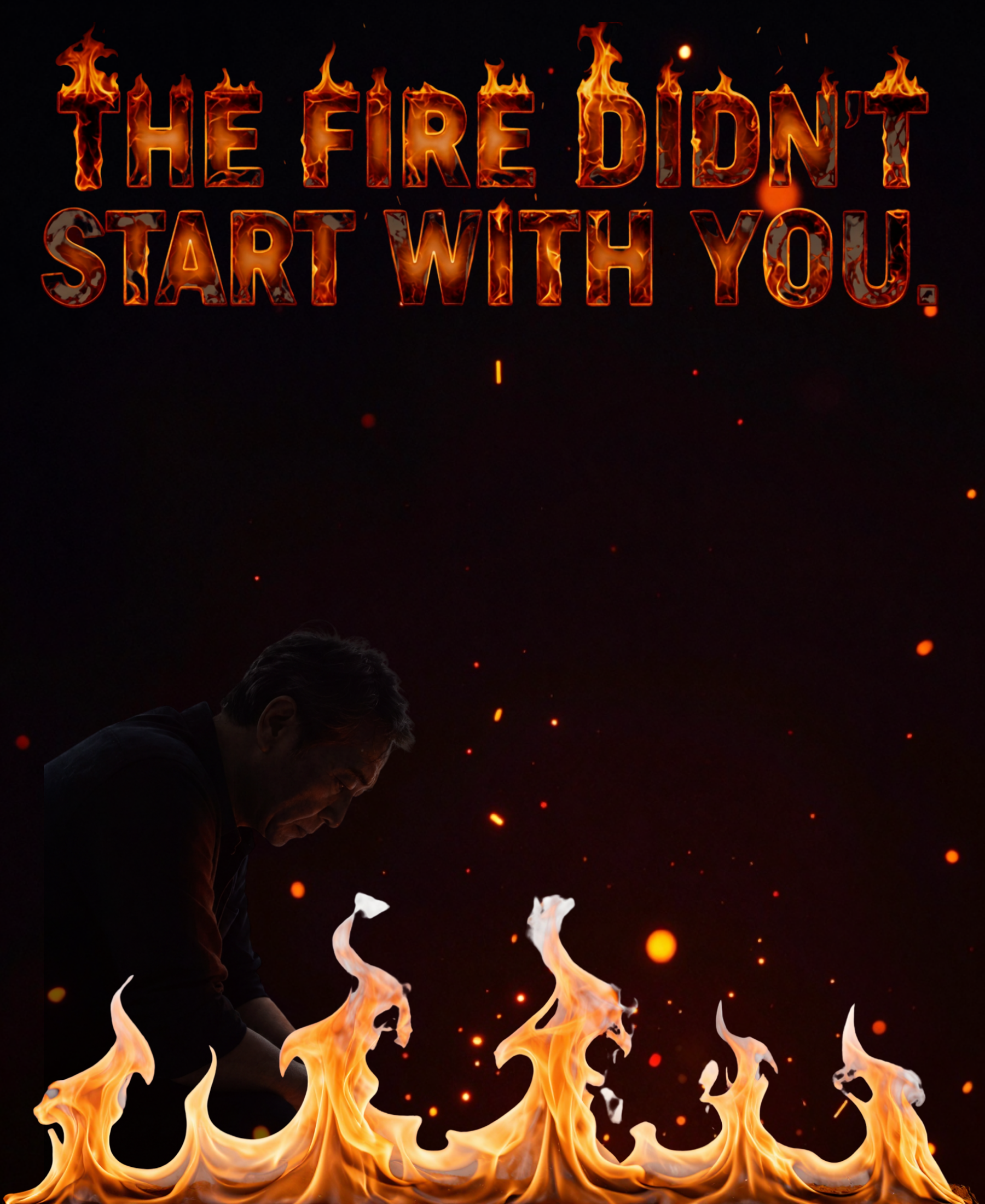
But what you carry forward is now your responsibility.

How Generational Conditioning and Intergenerational Trauma Contribute to the Midlife Crash & Burn
The anger feels personal.
The shame feels personal.
The emotional shutdown feels personal.
The addiction feels personal.
The fear feels personal.
The damage feels personal.
But much of what is burning inside you did not begin with you.
Before you ever made your first adult decision, forces were already shaping the man you would become.
Your family taught you what a man was supposed to be.
Your father taught you something, even if he rarely spoke.
Your mother taught you something.
Your brothers taught you something.
Your wounds taught you something.
Your silence taught you something.
Your church taught you something.
Your culture taught you something.
Your failures taught you something.
You learned what emotions were acceptable.
You learned what weakness cost.
You learned whether love was safe.
You learned whether truth was punished.
You learned whether conflict meant danger.
You learned whether men apologized.
You learned whether pain was faced or buried.
You learned whether affection was given or withheld.
You learned whether God was near, distant, angry, merciful, or mostly silent.
Long before your life visibly caught fire, the fuel was already being stacked. The fire did not start with you…
However, in spite of not having started the fire, the honest truth and harsh reality is the fact you’re still COLLAPSING under the weight of generations of inherited pain, conditioning, silence, fear, rage, emotional suppression, addiction, shame, and survival programming.
Further…
Consider this:
What if the crash didn’t start at 45?
What if the fire was already burning when he was 5?
But it reached you, and now you must decide whether you continue to live within the fire (leading to total personal collapse) or choosing the fire stopping with you.

Brother, the fire in your life may feel personal.
You inherited more than a last name.
Every family passes something forward.
Some pass courage.
Some pass faith.
Some pass discipline.
Some pass warmth.
Some pass wisdom.
Some pass honesty.
Others pass silence.
They pass rage.
They pass fear.
They pass addiction.
They pass emotional absence.
They pass control.
They pass shame.
They pass secrecy.
They pass the belief that men should never need help.
Most families pass a mixture of both.
That is why a man can love his family deeply and still recognize that something harmful was handed to him.
Recognizing the damage is not betrayal.
It is honesty.
You do not honor your family by pretending every pattern was healthy.
You honor truth by naming what was good, grieving what was missing, and refusing to pass the worst of it forward.
Some of what shaped you happened before you had language for it.
A little boy enters the world emotionally open.
Curious.
Soft-hearted.
Trusting.
Hungry for identity.
Hungry for belonging.
Hungry to know:
“Who am I?”
“What makes me valuable?”
“How does a man survive in this world?”
“How do I earn love?”
And then… the conditioning begins.
Not always through abuse.
Sometimes through love distorted by pain.
Sometimes through exhausted fathers.
Emotionally absent mothers.
Financial fear.
Religious confusion.
Alcohol.
Divorce.
Rage
Silence.
Performance pressure.
Shame.
Neglect.
Humiliation.
Criticism
Emotional starvation.
A boy does not understand generational conditioning.
He only understands what keeps him safe.
If anger controls the room, he learns to stay quiet.
If performance earns approval, he learns to perform.
If vulnerability is mocked, he learns to armor himself.
If love is inconsistent, he learns not to trust it.
If his father is distant, he may learn that masculinity means emotional absence.
If his mother depends on him emotionally, he may learn that love means carrying what was never his to carry.
If conflict becomes chaos, he may learn to avoid every hard conversation.
If home is unpredictable, he may learn to control everything he can.
If no one talks about pain, he may learn to bury his.
Those survival responses may have helped the boy endure.
But survival strategies carried into adulthood often become destructive patterns.
The boy stayed quiet to survive.
The man becomes emotionally unavailable.
The boy performed to earn approval.
The man becomes addicted to achievement, attention, sex, money, status, or praise.
The boy learned to control chaos.
The man becomes controlling.
The boy learned not to trust anyone.
The man isolates.
What protected the boy may eventually imprison the man.
And the child absorbs ALL OF IT.
Not logically.
Subconsciously.
Like wet cement taking fingerprints.
You may be living from a script you never chose.
Every man carries internal scripts.
Some sound like this:
“Men do not cry.”
“Never let anyone see weakness.”
“You are only worth what you produce.”
“Do not trust women.”
“Do not trust men.”
“Keep the peace at any cost.”
“Always stay in control.”
“Do not ask for help.”
“Sex proves you are wanted.”
“Anger is safer than sadness.”
“God helps men who do not need anyone else.”
Those scripts can operate for decades without being challenged.
A man may call them personality.
He may call them strength.
He may call them common sense.
But often they are old survival instructions written in a frightened boy and carried forward by an adult who never stopped to examine them.
The crash is sometimes the moment those scripts finally stop working.
The old instructions cannot hold the new pressure.
The structure breaks.
The man burns.
The crash did not create everything it exposed.
The collapse may look sudden.
The marriage breaks.
The job disappears.
The affair is discovered.
The addiction becomes visible.
The anger erupts.
The health fails.
The faith goes silent.
The man finally admits he does not recognize himself.
But the crash rarely began that day.
That day was the reveal.
The fracture may have started years earlier.
In childhood.
In adolescence.
In the first wound you never processed.
In the first secret you learned to protect.
In the first moment you decided weakness was dangerous.
In the first compromise that gave temporary relief.
The crash did not necessarily create the man you became.
It exposed him.
That is painful.
But exposure is also mercy.
You cannot rebuild what remains hidden.
Explanation is not excuse.
This is where a man must become careful.
Understanding your history matters.
Naming your wounds matters.
Recognizing conditioning matters.
Grieving what you did not receive matters.
Understanding trauma matters.
Seeing generational patterns matters.
But explanation can become dangerous when it turns into permission.
“My father was angry, so this is just how I am.”
“My family never talked, so I cannot communicate.”
“I was rejected, so I need attention.”
“I was betrayed, so I do not trust anyone.”
“I grew up around addiction, so this was inevitable.”
“I was never shown love, so I do not know how to give it.”
Brother, those statements may explain the road.
They do not excuse where you keep driving.
The fire may not have started with you.
But you are responsible for what you allow it to burn now.
You may not be responsible for what formed you.
But you are responsible for what you carry forward.
This is one of the hardest and most freeing truths in the Phoenix System.
You did not choose every wound.
You did not choose every family pattern.
You did not choose every childhood loss.
You did not choose every message you received.
You did not choose every burden placed on you.
But today, you have choices.
You can continue the pattern.
Or confront it.
You can pass it forward.
Or bring it into the fire.
You can defend the old script.
Or allow God to rewrite it.
You can blame the past for the man you are.
Or take responsibility for the man you now carry into the future.
Responsibility is not condemnation.
Responsibility is the doorway to change.
If everything is someone else’s fault, then nothing is within your reach.
But the moment you accept responsibility, movement becomes possible.
Forgiveness does not require denial.
Some men resist this work because they think naming family damage means dishonoring their parents.
It does not.
You can forgive and still tell the truth.
You can love your father and admit what he could not give.
You can honor your mother and acknowledge what she placed on you.
You can recognize that they were wounded people operating from wounds of their own.
You can understand that they may have passed forward what was handed to them.
But compassion does not require blindness.
Forgiveness does not make dysfunction healthy.
Grace does not erase consequence.
You can hold both truths:
They may have done the best they knew how to do.
And what they did still wounded you.
That honesty is not rebellion.
It is maturity.
Generational pain multiplies in silence.
What remains unnamed is often repeated.
The father who never processed grief becomes emotionally absent.
His son experiences the absence as rejection.
That son grows up, fears intimacy, and withdraws from his own family.
His children experience his withdrawal as rejection.
The same fire moves through another generation under a different name.
This is how pain travels.
Not always through deliberate cruelty.
Often through unexamined survival.
Silence passes it on.
Denial passes it on.
Pride passes it on.
The refusal to seek help passes it on.
The decision to face it can stop it.
What Is Generational Conditioning?
Some of what shaped you happened before you had language for it.
Generational Conditioning
Is the transfer of beliefs, emotional patterns, survival behaviors, coping mechanisms, identities, fears, and unspoken rules from one generation to the next.
It is not merely “teaching.”
It is identity imprinting.
A child watches:
- how dad handles stress
- how mom responds to conflict
- whether emotions are safe
- how love is given
- how anger is expressed
- how sexuality is treated
- whether vulnerability is punished
- whether God is portrayed through fear or relationship
- whether success equals worth
- whether failure equals shame
And then the child quietly concludes:
“This is what life is.”
“This is what men are.”
“This is what relationships feel like.”
“This is what I must become to survive.”
That becomes the script. A boy does not understand generational conditioning.
He only understands what keeps him safe.
If anger controls the room, he learns to stay quiet.
If performance earns approval, he learns to perform.
If vulnerability is mocked, he learns to armor himself.
If love is inconsistent, he learns not to trust it.
If his father is distant, he may learn that masculinity means emotional absence.
If his mother depends on him emotionally, he may learn that love means carrying what was never his to carry.
If conflict becomes chaos, he may learn to avoid every hard conversation.
If home is unpredictable, he may learn to control everything he can.
If no one talks about pain, he may learn to bury his.
Those survival responses may have helped the boy endure.
But survival strategies carried into adulthood often become destructive patterns.
The boy stayed quiet to survive.
The man becomes emotionally unavailable.
The boy performed to earn approval.
The man becomes addicted to achievement, attention, sex, money, status, or praise.
The boy learned to control chaos.
The man becomes controlling.
The boy learned not to trust anyone.
The man isolates.
What protected the boy may eventually imprison the man.
The fire can end with you.
Brother, you may be the first man in your family to name it.
The first to say:
“We do not keep hiding this.”
“We do not use anger to control the room.”
“We do not call emotional absence strength.”
“We do not protect addiction.”
“We do not shame vulnerability.”
“We do not pretend faith while refusing surrender.”
“We do not hand this fire to another generation.”
That does not make you better than the men before you.
It makes you responsible for the light you have now received.
You cannot change the beginning of the story.
But by the grace of God, you can change what leaves your hands.
You may be living from a script you never chose.
Every family has scripts.
Most are never spoken aloud.
Yet they control entire bloodlines.
Scripts like:
- “Men don’t cry.”
- “Handle it yourself.”
-“Don’t trust people.”
- “You better not embarrass this family.”
- “Achievement earns love.”
- “Stay quiet.”
- “Avoid conflict.”
- “Never look weak.”
- “Women can’t be trusted.”
- “Sex proves masculinity.”
- “Money equals value.”
- “God is angry.”
- “Your feelings don’t matter.”
A child doesn’t debate these scripts.
He absorbs them. And eventually… he becomes them.
The boy adapts to survive.
The man suffers because he adapted.
What Is Intergenerational Trauma?
Intergenerational Trauma
Is trauma passed from one generation to another through behavior, emotional modeling, nervous system patterns, fear responses, attachment wounds, and survival conditioning.
This means trauma is transferred:
- emotionally
- psychologically
- spiritually
- behaviorally
- relationally
A father does not need to intentionally abuse his son to pass trauma forward.
Sometimes trauma is passed through:
- emotional absence
- coldness
- unpredictability
- rage
- addiction
- criticism
- workaholism
- shame
- perfectionism
- silence
- emotional shutdown
- untreated depression
- sexual dysfunction
- fear-based religion
- abandonment
- betrayal
And the terrifying part?
Most parents pass down what THEY survived… Not what they healed.
The Trauma Pathway
How Conditioning Becomes Trauma
This is where the Phoenix System must tell the truth modern culture avoids.
Not all conditioning begins as trauma.
Sometimes it begins as adaptation.
But repeated unhealthy adaptation eventually becomes trauma inside the nervous system and identity structure of the child.
Here’s how the fire spreads.
Example 1: The Emotionally Silent Father
A young boy grows up hearing:
“Stop crying.”
“Man up.”
“Nobody cares.”
He survives by emotionally shutting down.
Years later he becomes a father himself.
He provides financially.
Works hard.
Loves his son in his own way.
But he never hugs his son deeply.
Never talks emotionally.
Never validates pain.
Never models emotional regulation.
The son learns:
- emotions are unsafe
- vulnerability is weakness
- silence equals masculinity
At 45 years old that same son:
- cannot communicate with his wife
- suppresses emotion
- explodes in anger
- feels emotionally dead
- secretly feels unloved
- uses porn, affairs, gambling, alcohol, or work to escape emptiness
And he thinks:
“Something is wrong with me.”
No brother.
Something was FORMED in you.
Example 2 — The Performance-Based Household
A child only receives attention when:
- succeeding
- performing
- winning
- behaving perfectly
Love becomes conditional.
The subconscious belief becomes:
“I must achieve to deserve love.”
That boy grows into a midlife man who:
- becomes addicted to proving himself
- chases status
- fears failure
- ties identity to career
- cannot rest
- panics when aging begins
- collapses after job loss or retirement
- cheats sexually for validation
- burns out physically and emotionally
Because underneath the adult man… is still a terrified little boy trying to earn approval.
Example 3 — Addiction Transfer
Grandfather drank to escape war trauma.
Father drank to escape emotional pain.
Son turns to:
- pornography
- risky sex
- gambling
- drugs
- dopamine addiction
- social media
- compulsive achievement
- emotional affairs
Different substances. Same wound.
The behavior changes. The trauma survives.
The Nervous System of the Burned Man
Many midlife men are not merely “making bad choices.”
Their nervous systems were forged in survival mode.
That creates:
- hypervigilance
- emotional suppression
- compulsive behavior
- avoidance
- rage
- people pleasing
- sexual acting out
- fear of abandonment
- inability to trust
- emotional numbness
- shame spirals
- chronic anxiety
- depression
- self-sabotage
Then midlife arrives.
And midlife removes distractions.
The marriage strains.
The body ages.
The career shifts.
The kids leave.
The hormones change.
The energy drops.
The mirror becomes unavoidable.
And suddenly… everything buried underneath starts screaming through the ashes.
The Midlife Crash Is Often Delayed Trauma Exposure
Most men call it:
- burnout
- depression
- affair season
- identity crisis
- losing themselves
- male failure
But often… the midlife crash is the first time the original wounds can no longer stay buried.
The survival mask stops working.
The little boy underneath finally surfaces.
Not to destroy the man.
But to expose what was never healed.
Midlife didn’t create the fire.
It exposed what had been burning underneath for decades.
How Trauma Passes to the Next Generation
Here is the tragedy.
A burned man who never confronts his conditioning usually transfers it unconsciously.
Not because he is evil.
Because unexamined pain becomes inherited identity.
The emotionally absent father creates emotionally starving children.
The rage-filled father creates anxious children.
The shame-filled mother creates insecure children.
The addicted parent creates survival-focused children.
The hypercritical home creates perfectionists.
The silent home creates emotionally disconnected adults.
And the cycle repeats.
Generation after generation.
Ashes handed to ashes.
God is not asking you to erase your history.
He is asking you to surrender it.
God does not rebuild a man by pretending the wounds never happened.
He brings truth into them.
He reveals what was formed there.
He exposes the agreements made there.
He confronts the lies learned there.
He heals what can be healed.
He disciplines what must be changed.
He calls the man into obedience where survival once ruled.
Your past may explain your reflexes.
It does not have the authority to become your lord.
Christ does not call you to remain imprisoned by inherited patterns.
He calls you into truth.
Into repentance.
Into forgiveness.
Into renewal.
Into brotherhood.
Into a different way of living.
This is what the fire reveals.
The fire reveals the difference between what happened to you and what now lives through you.
It reveals where pain became pride.
Where fear became control.
Where neglect became emotional distance.
Where rejection became lust for validation.
Where silence became dishonesty.
Where survival became identity.
This is not exposure for exposure’s sake.
God exposes so that what has ruled the man can finally be surrendered.
The fire reveals.
The forge rebuilds.
Ask the harder questions.
What did the men in your family teach you about masculinity?
What emotions were safe in your home?
What happened when someone told the truth?
How was anger handled?
How was affection shown?
What did your family do with grief?
What did they do with addiction?
What did they do with failure?
What did they teach you about God?
What did you learn about your worth?
What patterns are now showing up in your marriage, your fatherhood, your work, your friendships, your body, your private life, and your faith?
And the hardest question:
What are you still calling “just who I am” that may actually be an old wound running the man?
Do not answer quickly.
Let the question burn.
Brother, this can stop with you.
You do not have to curse the men who came before you.
You do not have to excuse them either.
You can grieve.
You can forgive.
You can confront.
You can repent.
You can repair.
You can rebuild.
You can choose differently.
You can become the man who finally says:
“I did not start this fire.”
“But by the grace of God, I will not keep feeding it.”
“I will not hand it to my wife.”
“I will not hand it to my children.”
“I will not hand it to another generation.”
The fire did not start with you.
But it can end with you.
DO NOT TURN YOUR HISTORY INTO A HIDING PLACE
Understanding where the fire came from is only the beginning.
The next question is whether you are using your history to explain the pattern—or justify it.
Their crash is:
- generational
- psychological
- spiritual
- emotional
- relational
- subconscious
The midlife crash and burn is often the collision between:
1. childhood conditioning
2. inherited trauma
3. suppressed emotion
4. masculine performance pressure
5. identity confusion
6. unresolved pain
7. spiritual disconnection
8. decades of survival-mode living
The Phoenix System exists because many men are not merely failing in midlife.
They are COLLAPSING under inherited emotional architecture they never consciously chose.
Phoenix System Truth
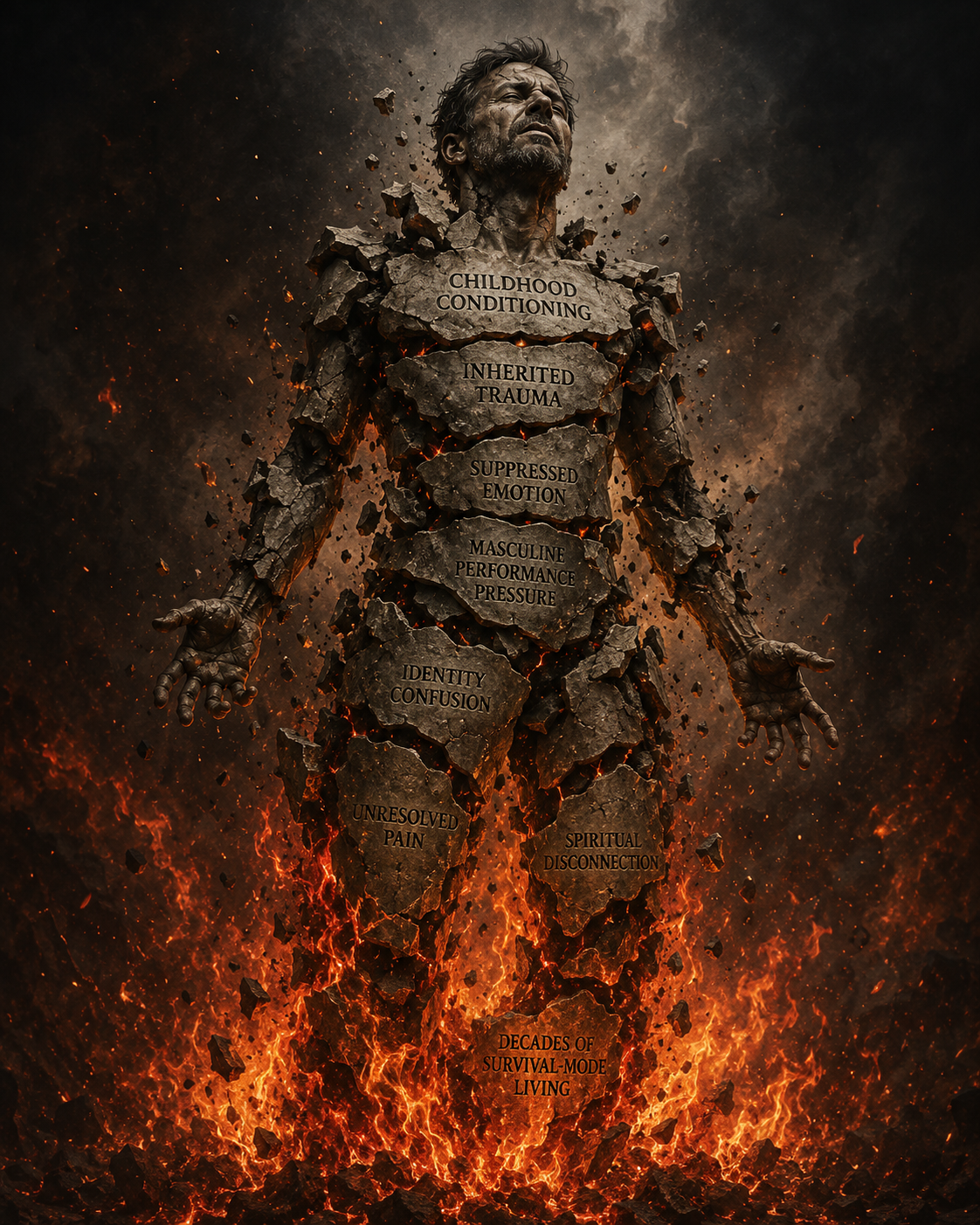
Eventually the structure cannot hold.
And the man burns.
But Here Is the Hope
The crash can become the interruption of the bloodline.
A man who confronts:
- his conditioning
- his trauma
- his inherited scripts
- his emotional shutdown
- his addictions
- his false masculinity
- his subconscious beliefs can stop handing the fire forward.
That is what rebuilding actually is.
Not self-improvement.
Not image management.
Not motivational slogans.
It is becoming conscious of the script that built you… so you can finally stop living it unconsciously.
Final Fire
Brother… your crash may feel personal.
But parts of it are generational.
You may be carrying:
- your father’s silence
- your grandfather’s fear
- your family’s shame
- your household’s emotional rules
- inherited survival patterns decades old
And none of that excuses destructive behavior.
But it DOES explain why the fire feels deeper than simple bad decisions.
The Phoenix System is not about blaming parents.
It is about finally becoming the man willing to end the transmission.
Because if one man heals…
future generations inherit something different.
And maybe for the first time in your bloodline… the ashes stop with you.
DO NOT TURN YOUR HISTORY INTO A HIDING PLACE
Understanding where the fire came from is only the beginning.
The next question is whether you are using your history to explain the pattern—or justify it.
See how pain, pressure, temptation, secrecy, and shame become a repeating cycle.
Expose the inner argument that keeps protecting what the fire revealed.
Find out where the pressure may already be showing in your life.